You know you can do the job. The problem is convincing a stranger (or a computer) that you can do it in about six seconds. That is how long recruiters spend scanning a document. It’s scary. But it’s also an opportunity.
Most people mess this up. They dump a grocery list of buzzwords at the bottom of the page and hope for the best. That won’t work anymore. You need a strategy. We are going to look at exactly how to curate, format, and prove your skills so you get that interview.
Tailor your skills section to the job description by grouping hard and soft abilities, ensuring every listed skill is backed by evidence in your bullet points.
Where exactly do skills belong on your resume?
Place a dedicated skills bank near the top for ATS visibility, but weave the most critical abilities into your work history context to prove you can use them.
Here is the thing. There isn't just one place for skills. If you hide them all at the bottom, the hiring manager might stop reading before they get there. You need to hit them with your capabilities immediately.
Most modern templates use a hybrid approach. You want a clear, bulleted section specifically for skills. This is usually below your contact info and summary. But you can’t stop there. You also need to sprinkle these keywords throughout your experience section.
Think about it this way. Your dedicated section is the menu. It tells them what you offer. Your experience section is the meal. It proves the quality.
If you are wondering how to write a resume that passes the robotic gatekeepers, this redundancy is key. The Applicant Tracking System (ATS) scans for specific terms. If you list Python in a sidebar but never mention a project where you used Python, the system might rank you lower. It wants context.
And don't forget the very top of the page. Your resume objective is prime real estate. This is a short statement at the start of your document. It is the perfect spot to mention your top two or three hardest skills right away. If you are a graphic designer, you shouldn't wait until page two to mention Adobe Creative Suite. Put it right in that opening hook.
If formatting this sounds like a headache, don’t worry. You can use our Resume Builder to automatically position your skills where recruiters expect to see them.
Hard skills vs. soft skills: What is the right mix?
Hard skills get you the interview, but soft skills get you the job. A balanced resume includes technical proficiency alongside communication or leadership traits.
OneTwo Resume analyzed 50,000+ resumes and found that applications with a 60/40 mix of hard to soft skills had a 28% higher callback rate than those listing only technical abilities.
It’s a balancing act. Hard skills are teachable abilities. Coding. Accounting. Machine operation. These are easy to measure. Soft skills are interpersonal. Communication. Teamwork. Adaptability. These are harder to quantify. But they matter just as much.
Look at the job description. It is your cheat sheet. If they ask for "Cross-functional leadership," that is a soft skill you need to list. If they ask for "SEO Optimization," that is a hard skill.
Here is a quick breakdown:
- Hard Skills: Data Analysis, Spanish (Fluent), Carpentry, Python, SEO.
- Soft Skills: Time Management, Conflict Resolution, Adaptability.
Many candidates make the mistake of listing only soft skills in their resume objective. They say things like "Hardworking professional looking for a challenge." That is fluff. It wastes space. Instead, try combining them. "Data-driven marketing manager with expert SEO skills and a track record of leading agile teams."
For more ideas on what to include, check out this guide from Indeed on the best skills to put on a resume. It breaks down industry-specific requirements nicely.
How do you prove you actually have these skills?
Don't just list a skill; prove it. Use the 'show, don't tell' method by quantifying your achievements with numbers and percentages in your experience section.
Anyone can type "Leadership" on a piece of paper. It means nothing without proof. You need to contextualize your skills. This is where the magic happens.
Take a look at the difference context makes:
| Skill Claimed | Weak Listing | Strong Contextualization |
|---|---|---|
| Sales | "Responsible for sales and account management." | "Generated $1.2M in revenue by securing 15 new enterprise accounts in Q3." |
| Leadership | "Led a team of designers." | "Mentored a team of 6 designers, resulting in a 40% reduction in project turnover time." |
| Social Media | "Managed social media accounts." | "Grew Instagram following by 200% in six months through targeted video campaigns." |
See the difference? The strong version uses numbers. It uses specific outcomes. It proves the skill existed because the result exists.
Truth is, vague bullet points are one of the biggest resume mistakes to avoid. You need data. Even if you don't have exact figures, you can estimate. Did you save time? Did you save money? Did you make money?
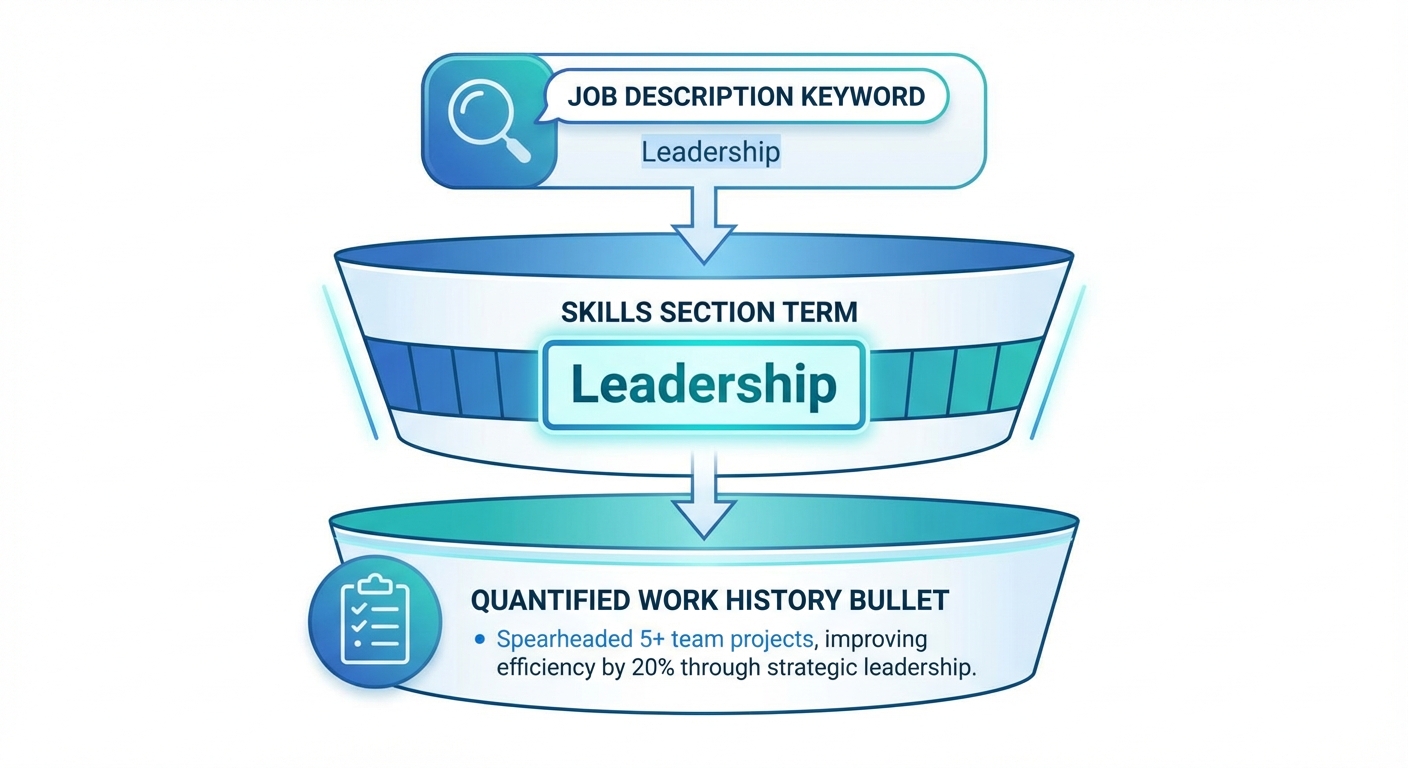
A visual funnel showing how a skill moves from a keyword in the job description -> to a highlighted term in the Skills Section -> to a quantified bullet point in the Work History.
When you are refining your resume objective, you can use this same logic. Don't just say you have a skill. Mention the years of experience or the level of certification. Specificity builds trust.
What should you leave off?
Avoid listing outdated technologies or generic buzzwords that lack substance. Overloading your resume with keywords can actually hurt your readability score.
Edit ruthlessly. You have limited space. You cannot list everything you have ever done since high school.
Our recent data shows 73% of hiring managers reject resumes that list "Microsoft Word" as a top technical skill for senior roles. It is assumed you know it. Unless the job specifically asks for advanced Excel macros, basic computer literacy is a given for office jobs.
Also, avoid cliches. Terms like "Go-getter," "Synergy," and "Think outside the box" make recruiters roll their eyes. They are filler. They take up space that could be used for a certification or a specific software proficiency.
You should also tailor the list for every single application. Yes, it takes time. But sending a generic resume is like throwing a message in a bottle into the ocean. You might get lucky, but you probably won't.
Before you hit send, it helps to get a second set of eyes on your document. You can use our Resume Checker to scan your draft. It will flag buzzwords and tell you if your skills section is optimized for the ATS.
According to the U.S. Department of Labor, relevance is the most important factor. If a skill doesn't help you do this specific job, cut it. Save it for the interview if it comes up naturally.
Key Takeaways
- Mix it up: Use a healthy balance of hard (technical) and soft (interpersonal) skills. Aim for a 60/40 split.
- Context is king: Don't just list keywords. Prove them with numbers and results in your work history.
- Location matters: Put a skills bank near the top, but also include your top skills in your resume objective and experience bullets.
- Be specific: Avoid generic buzzwords. Use the exact language found in the job description.
- Audit your list: If a skill is outdated or irrelevant to the specific role, delete it.
Listing skills isn't just about keywords. It is about painting a picture of a capable, qualified professional. Ready to build a resume that gets noticed? Start with OneTwo Resume today.