You are staring at a blinking cursor. It is the worst part of writing a resume. You know you have talent. You know you can do the job. But figuring out exactly how to list skills on a resume without looking like you are just copying the dictionary is tough.
Do you list everything you have ever done? Do you only list the technical stuff? And what about the dreaded "soft skills" section?
Here is the thing. Most people get this wrong. They treat the skills section like a junk drawer where they toss in every buzzword they know. Hiring managers hate that. They want clarity. They want relevance. Writing a professional resume means making hard choices about what stays and what goes.
Tailor your skills section to the job description by grouping hard and soft skills into clear categories rather than listing them randomly.
Where do skills belong on a professional resume?
Place your technical skills near the top for IT roles, but weave soft skills into your work history bullet points for management positions.
Location matters. You wouldn't put the engine of a car in the trunk. The placement of your skills section depends entirely on your industry and experience level.
If you are in tech, engineering, or a creative field like graphic design, your skills are your currency. Put them up top. Right under your summary. You want the recruiter to see "Python," "Project Management," or "Adobe Suite" before they even look at where you went to school.
But if you are in sales, customer service, or executive leadership? It is different. Your results matter more than your tools. In this case, move the skills section to the bottom or use a side column. This creates a clean layout that highlights your achievements first.
We looked at the numbers to back this up. OneTwo Resume analyzed 50,000+ resumes and found that resumes with a dedicated skills sidebar had a 24% higher read rate than those with skills buried at the very bottom.
It is about visual hierarchy. You are guiding the reader's eye. If you are struggling with formatting this correctly, our Resume Builder handles the layout logic for you so you don't have to mess with margins for three hours.
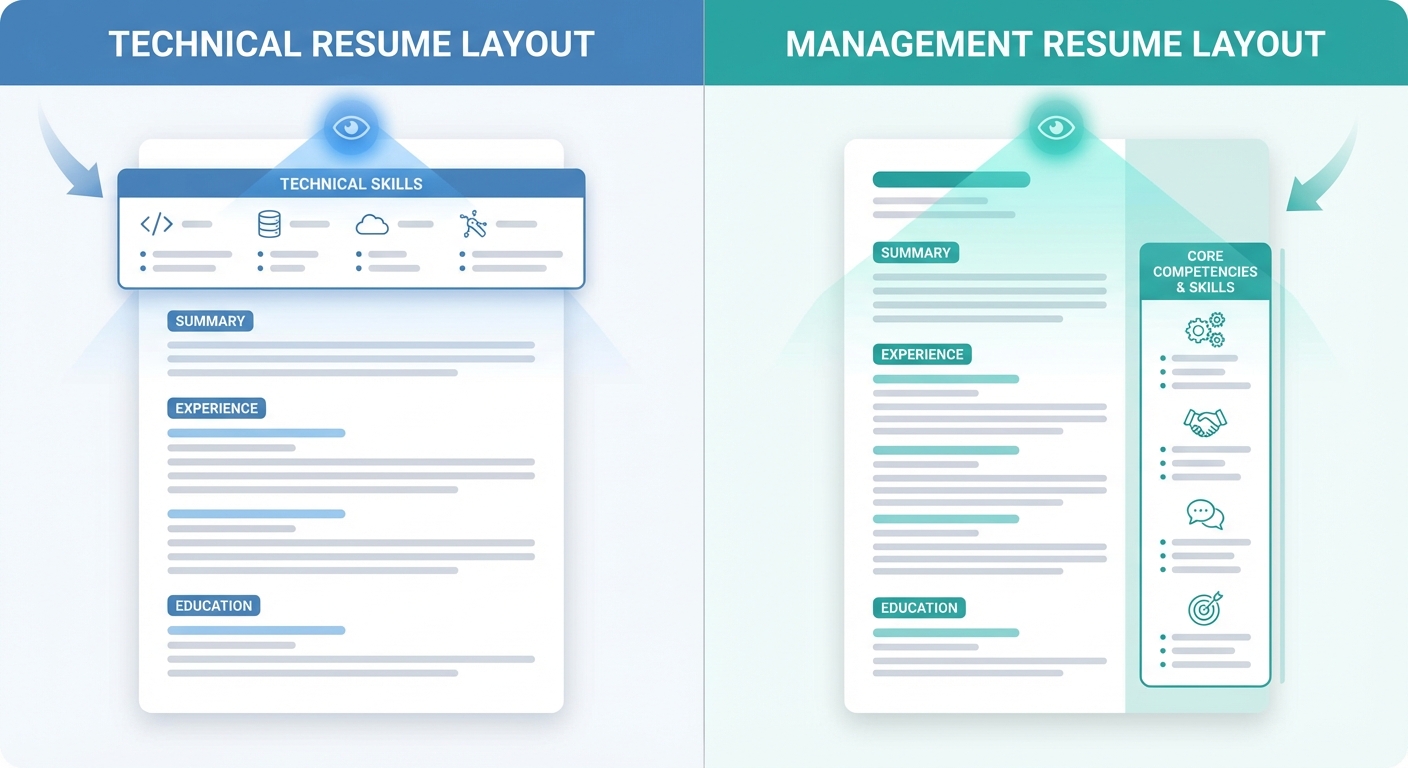
A split-screen visual showing a 'Technical Resume' layout with skills at the top versus a 'Management Resume' layout with skills in a side column, highlighting where the recruiter's eye lands first.
What is the right balance between hard and soft skills?
Prioritize hard skills that match the specific software or certifications requested, then back them up with soft skills demonstrated in your experience section.
Here is where it gets tricky. Hard skills are teachable abilities. Coding, accounting, machine operation. Soft skills are interpersonal. Communication, teamwork, adaptability.
You need both. But you cannot list them the same way.
Listing "Good Communicator" in a bulleted list is weak. It proves nothing. Anyone can type that. Instead of wasting space in your skills section on generic fluff, prove it in your work history.
Don't say "Leadership." Say "Led a team of 10 sales associates to exceed quarterly targets by 15%." See the difference? One is a claim. The other is proof.
For hard skills, be specific. Don't just write "Microsoft Office." That is assumed in 2024. It's like listing "typing" or "reading." Unless the job specifically asks for advanced Excel macros, leave the basics off. Focus on the specialized tools that make you valuable.
For more ideas on what qualifies as a high-value competency, check out this guide from Indeed Career Advice: Best Skills to Put on a Resume. It breaks down industry demands well.
Here is a breakdown of how to upgrade your skills for resume sections:
| Lazy Listing (Avoid) | Effective Listing (Do This) |
|---|---|
| Communication | Presented monthly strategy reports to C-suite executives |
| Microsoft Excel | Advanced Excel (VLOOKUP, Pivot Tables, Macros) |
| Leadership | Mentored 4 junior developers and managed sprint workflows |
| Spanish | Bilingual (English/Spanish) - ILR Level 4 |
| Hard Worker | Consistently met deadlines 3 days ahead of schedule |
And remember relevance. Our recent data shows 73% of hiring managers admit they skim the skills section in less than 10 seconds. If they see "Underwater Basket Weaving" on an accounting application, they might assume you don't understand professional norms. Keep it relevant.
How do you beat the applicant tracking system?
Use the exact phrasing found in the job description because ATS software matches keywords character-for-character to score your application.
Robots read your resume before humans do. That is the hard truth of the modern job market. The Applicant Tracking System (ATS) scans for keywords. If you don't have them, you don't get seen.
But don't panic. You don't need to cheat the system. You just need to speak its language.
Look at the job posting. Does it say "Customer Relationship Management" or "CRM"? Does it say "SaaS Sales" or "Software Sales"? Use the exact phrase they use. If they use an acronym, you use the acronym (maybe with the full spelled-out version in parentheses just to be safe).
If you want to know which terms are standard for your target job, the U.S. Bureau of Labor Statistics: Occupational Outlook Handbook is a goldmine for standard industry terminology.
Creating a professional resume isn't about keyword stuffing. That is when you hide white text on a white background or list "Java" fifty times. The ATS is smarter than that now. It looks for context.
If you are unsure if your document will pass the robot test, you should run it through a scanner. Our Resume Checker scores your content against standard ATS parameters to show you exactly what is missing before you hit send.
Key Takeaways:
- Location: Put technical skills at the top for tech jobs, and soft skills in the sidebar or work history for management roles.
- Specifics: Never list generic soft skills alone. Prove them with data in your work history.
- Relevance: Only list skills that actually matter to the specific job you are applying for.
- Keywords: Mirror the language from the job description to pass the ATS scan.
- Format: Use a clean, readable layout that highlights your strongest assets immediately.
Writing a resume doesn't have to be a nightmare. It is just a puzzle. You have the pieces. Now you know how to fit them together. If you want to build a standout application in minutes rather than hours, give OneTwo Resume a try. Your next job is waiting.