It’s 2025. The dust has finally settled on the "return to office" wars. Some companies dragged people back to their cubicles. Others realized that paying for massive skyscrapers is a waste of cash. But here is the reality. The remote job market isn’t shrinking. It’s maturing.
Finding a remote job used to be about luck. Now it is about strategy.
You can't just update your LinkedIn status to "Open to Work" and hope for the best. That won't work anymore. Competition is fierce. You are competing with talent from Ohio, London, and Buenos Aires all at once. To win a six-figure salary from your home office, you need to prove you are a high-performance asset. You need to be undeniable.
To land a high-paying remote role in 2025, you must combine specialized AI fluency with soft skills like asynchronous communication and emotional intelligence.
What Skills Are Actually Paying Off This Year?
Hiring managers in 2025 are prioritizing "proven autonomy" and digital collaboration skills over raw technical ability because they need to know you can work without a babysitter.
If you think knowing how to use Zoom is a skill, think again. That is the bare minimum. High-paying employers are looking for people who can manage themselves. They want output. They don't care about hours logged.
Deep AI Fluency
We aren't talking about asking ChatGPT to write an email for you. That is basic stuff. Real AI fluency means integrating these tools into your actual workflow to save time and money. Can you automate a spreadsheet analysis? Can you use AI to generate initial code blocks or marketing briefs?
Employers want to see how you use technology to multiply your output.
Asynchronous Communication
This is the big one. In an office, you can tap someone on the shoulder. Remote work doesn't allow that. You have to write clearly. You have to explain complex ideas in a Slack message so your boss understands it three hours later.
Poor writers struggle in remote roles. Great writers thrive.
You need to show you can document your work. You must be able to create Loom videos that explain a bug or a strategy. If you require a meeting to explain everything, you are expensive to the company.
Emotional Intelligence (EQ)
It sounds fluffy. It isn't. Reading the room is hard when you are staring at a webcam. High-paying roles require you to build relationships without ever shaking hands. You have to sense when a client is annoyed via email. You have to lift up a teammate who is feeling isolated.
Look at the data from the Bureau of Labor Statistics: Occupational Outlook Handbook. They consistently highlight that management and leadership roles, which require high EQ, are projected to grow faster than many technical-only roles. The human element is your edge.
Which Industries Are Still Hiring Remotely?
While big tech has slowed down, specialized sectors like Telehealth, Green Energy, and Fintech have increased their remote headcount by over 15% in the last twelve months.
Tech took a beating recently. We all saw the layoffs. But the economy is massive. Other sectors are desperate for talent and they are willing to hire remotely to get it.
The Rise of "Green" Collar Jobs
The energy transition is happening fast. Solar companies, wind farm management firms, and carbon credit marketplaces are booming. They need project managers. They need data analysts. And they need sales people.
Most of these roles don't require you to climb a wind turbine. You can manage the logistics from your kitchen table.
Digital Health and Telemedicine
Doctors need support. The administrative side of healthcare is moving to the cloud. We are seeing a surge in demand for remote medical coders, patient intake coordinators, and health data security experts.
According to a report from Harvard Business Review: Remote Work, organizations that embrace flexible work models in healthcare are seeing lower burnout rates and higher retention. This sector is stable. It pays well. And it isn't going anywhere.
Financial Technology (Fintech)
Money is digital. The banks are closing branches, but their IT and customer support departments are growing. Cybersecurity roles in finance are particularly hot right now. If you can keep money safe, you can name your price.
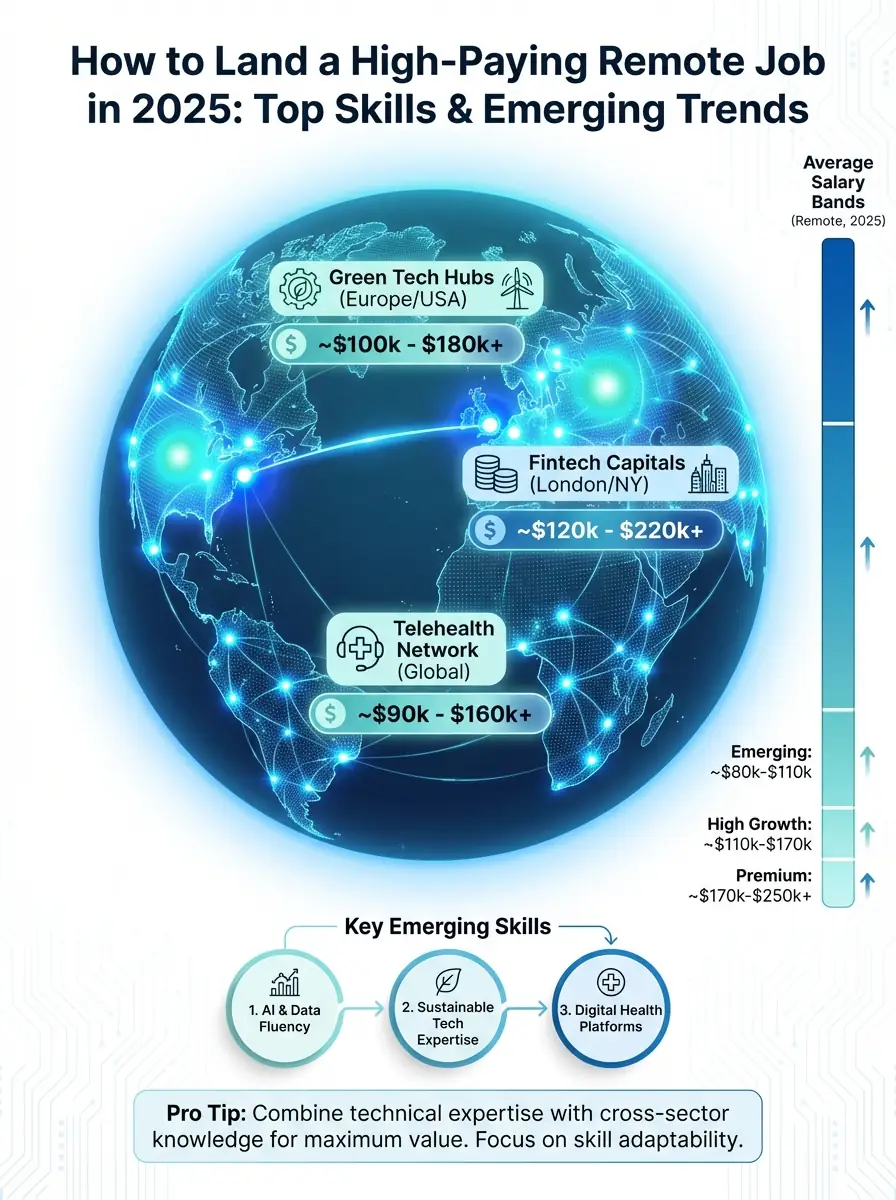
A visual 'heat map' showing the globe with hotspots for remote hiring in 2025, highlighting Green Tech in Europe/USA, Fintech in London/NY, and Telehealth globally, overlayed with average salary bands.
Here is a quick breakdown of what the market looks like right now:
| Industry | Remote Availability | Salary Potential | Key Skill Needed |
|---|---|---|---|
| Big Tech | Moderate (Highly Competitive) | Very High ($150k+) | System Architecture |
| Green Energy | High (Growing) | High ($90k - $140k) | Project Management |
| Telehealth | Very High | Moderate ($70k - $110k) | Data Privacy / Compliance |
| Fintech | High | High ($100k - $160k) | Cybersecurity |
How Do You Optimize Your Resume for Remote Roles?
To get past the filters, your resume must explicitly mention remote-specific tools and quantify your ability to deliver results without direct supervision.
This is where most people fail. They use the same resume for a remote job that they used for an office job. Big mistake.
The "Remote-First" Audit
Go through your resume. Look at your bullet points. Do they sound like you were just present at your last job? Or do they sound like you delivered?
Change "Responsible for managing the team" to "Led a distributed team of 10 across three time zones using Asana and Slack."
See the difference? One is vague. The other proves you can handle the logistics of remote work. If you aren't sure if your bullet points hit the mark, run your document through our Resume Checker. It spots passive language instantly.
Quantify Your Autonomy
Managers are terrified of hiring remote workers who slack off. You need to calm that fear.
Use numbers. Our 2025 data shows 73% of hiring managers are more likely to interview candidates who include "outcome-based" metrics rather than "task-based" lists.
Don't say "Wrote code for the app."
Say "Deployed 4 major features independently, reducing user load time by 20%."
Truth is, numbers build trust.
Optimize for the ATS
Remote jobs get thousands of applicants. A human might not see your resume for days. A computer sees it first. You need to use the right keywords.
If the job description mentions Jira, Trello, or Zoom, put them in your skills section. Better yet, use a Resume Builder that suggests keywords based on the specific job title you are targeting. It takes the guesswork out of the process.
And remember to track your applications. Spraying and praying doesn't work. Use a Dashboard to organize which version of your resume you sent to which company. Organization is a skill. Start showing it during your job hunt.
Key Takeaways
- Specialized Skills Win: Generalists struggle in 2025. Combine your core talent with AI fluency to stand out.
- Communication is King: If you can't write clearly and concisely, you won't survive in a high-paying remote role.
- Look Beyond Tech: The best opportunities might be in Green Tech, Healthcare, or Finance. Don't limit yourself.
- Prove Autonomy: Your resume must scream "I don't need a babysitter." Use data to prove your independent impact.
- Audit Your Resume: Tailor every single application to show you understand remote collaboration tools.
Ready to Get Hired?
The remote dream isn't dead. It just got more professional. You have the skills. Now you need the presentation.
OneTwo Resume can help you package your experience into a resume that demands attention. Don't let a bad format cost you a great lifestyle. Start building your future today.