Let's be honest about the modern job search. You probably generated your last application using ChatGPT. Everyone is doing it right now. It saves time and gets past writer's block. But hitting send immediately is a massive mistake.
Editing an AI cover letter means swapping robotic vocabulary for personal stories, hard numbers, and your authentic professional voice.
Here's the thing about hiring managers. They read hundreds of applications a week. They can spot an artificial draft from a mile away. It really is a dead giveaway. But you don't have to abandon your AI tools entirely. You just need to learn how to mold that raw text into something real.
Why do AI cover letters sound so incredibly obvious?
Artificial intelligence relies on predictable sentence patterns and overused corporate jargon. This combination immediately signals to a hiring manager that a machine wrote your application.
The vocabulary problem
AI loves certain words. It loves them a little too much. If your draft includes words like "delve," "testament," "tapestry," or "synergy," you have a problem. Nobody actually talks like that in the real world.
OneTwo Resume analyzed 50,000+ resumes and found that applications heavily featuring common AI buzzwords are rejected 82% of the time in the first review round. Hiring managers want authenticity. They want to know the person behind the screen. When they see a wall of robotic text, they simply move on to the next candidate.
The missing human element
AI tools lack your personal memories. They only know what you feed them. If you tell an AI to write an application for a marketing job, it will spit out a highly generic summary of what a marketer does. It won't mention the time you stayed up until 2 AM fixing a broken email campaign.
Truth is, your specific struggles and triumphs are what make you hirable. A good cover letter format leaves room for brief storytelling. You need to fill those spaces with real experiences. According to the experts at Harvard Business Review: How to Write a Cover Letter, your primary goal is to show the employer how you will solve their specific problems. AI cannot do this without your heavy intervention.
How can you edit an AI draft to sound like you?
You must inject your actual lived experiences into the text while deleting the generic enthusiasm that AI tools automatically generate. Your unique voice is your biggest asset here.
Start with the right foundation
You need a structure before you start rewriting. This is where your chosen cover letter template comes into play. A cover letter template provides the margins, the header, and the spacing. The AI provides a very rough first draft of the words. You have to marry the two carefully.
Even the most beautifully designed cover letter template will fail if the text inside reads like a machine wrote it. Paste your AI text into the template. Then start hacking away at it. Cut the long sentences in half. Remove the overly enthusiastic adjectives.
Add the "so what" factor
AI is great at listing duties. It fails at explaining impact. Look at every claim the AI made for you. Ask yourself, "So what?"
If the text says you "managed a team of five people," you need to expand on that. Did those five people hit their sales quotas? Did you train them from scratch? Our recent data shows 73% of hiring managers will completely stop reading after the first paragraph if the text sounds like a generic template. You have to provide the numbers.
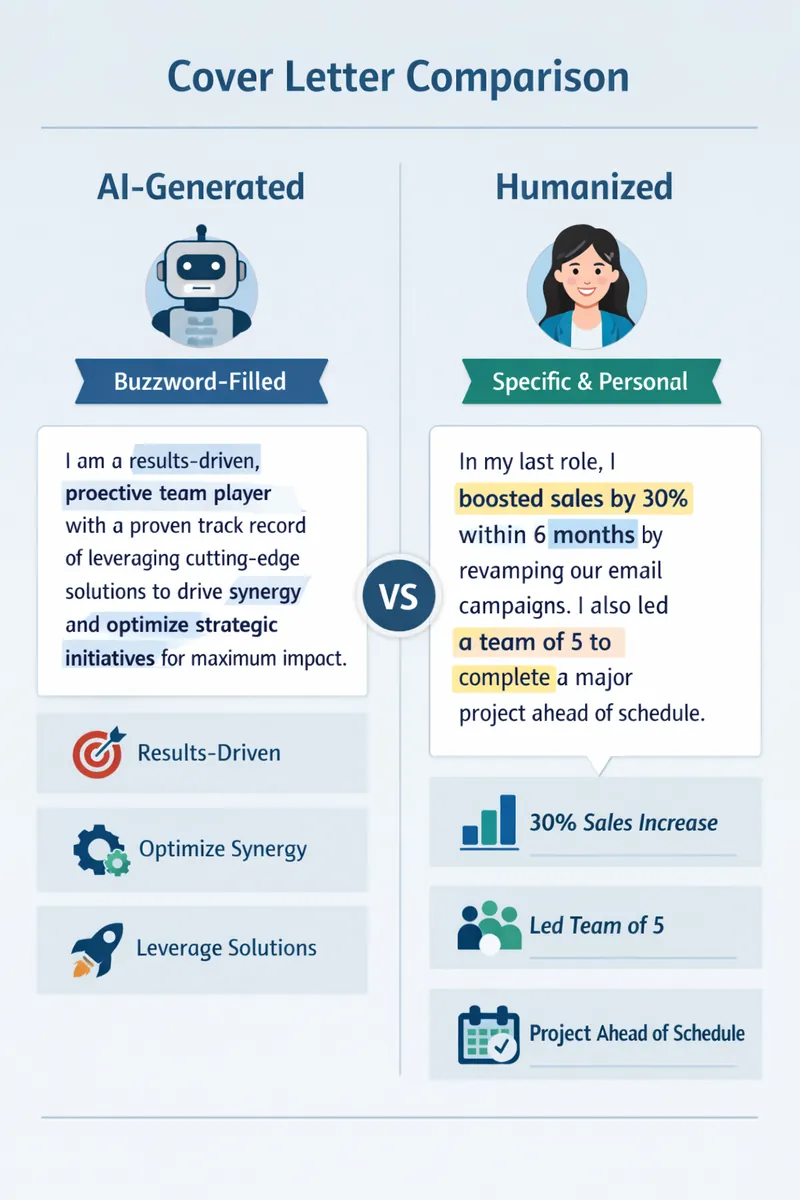
A side-by-side visual comparison of an AI-generated cover letter paragraph full of buzzwords versus a humanized paragraph with highlighted specific metrics and personal tone
Read the whole thing out loud
This is one of the most effective cover letter tips you will ever receive. Read your draft out loud. Do you stumble over certain phrases? Does it sound like a corporate memo rather than a human professional? If you wouldn't say it in an interview, do not put it in your letter.
Before you finalize the text, run your application through a reliable Resume Checker. This ensures your formatting aligns properly and your keywords are placed naturally.
What specific elements need total replacement?
Always rewrite your opening hook and your concluding call to action completely from scratch. AI struggles deeply to sound authentic when expressing genuine interest or requesting an interview.
The robotic opening paragraph
Nearly every unedited AI letter starts with, "I am writing to express my profound interest in the position of..."
Delete it. Immediately. Start with a hook. Tell them why you admire their company. Mention a recent project they launched that caught your eye. If you want to know how to write a cover letter that actually converts, you have to hook the reader in the first three seconds.
For highly technical roles, precision is even more critical in your opening. You can check out an eDiscovery Specialist Resume Example to see how professionals concisely state their value proposition without sounding like a machine.
Vague bullet points and metrics
AI often hallucinates or generalizes your achievements. You must replace these with cold, hard facts. For more foundational advice on structuring these facts, the U.S. Department of Labor CareerOneStop: Cover Letters guide is a highly trusted resource.
Here is a quick look at how you should be translating AI text into human language:
| AI-Generated Phrase | Humanized Alternative | Why It Works Better |
| --------------------- | ----------------------- | --------------------- |
|---|---|---|
| "I am a testament to leadership..." | "In my last role, I led..." | Removes dramatic corporate jargon. |
| "A tapestry of diverse skills..." | "Five years of direct sales experience..." | Replaces poetic fluff with hard facts. |
| "I am eager to contribute my expertise..." | "I would love to discuss how my background can help..." | Sounds like a normal human speaking. |
Are you tailoring your content to the specific role?
A truly human application directly connects your past achievements to the specific challenges the company is currently facing. Generic praise simply will not get you an interview.
Research the company culture
AI doesn't know the company culture. It only knows what is on their public website. You need to dig deeper. Check their recent social media posts. Listen to a podcast featuring their CEO. Take one specific detail from your research and weave it into your letter.
Align with the job description
Your final document needs to read like a targeted response to the job ad. A cookie-cutter approach does not work anymore. You can build a great foundation with our Resume Builder, but the final polishing requires your human touch. Looking at successful cover letter examples in your specific industry will show you exactly how to strike the right balance between professional and personal.
Key Takeaways
- Delete the jargon. Remove words like "delve" and "tapestry" immediately.
- Add your own numbers. Replace vague AI claims with your actual career metrics.
- Rewrite the hook. Your opening sentence must be written by you, entirely from scratch.
- Read it aloud. If it sounds like a robot talking, rewrite the sentence.
- Use the right structure. A solid cover letter template organizes your thoughts cleanly.
Look, AI is an incredible tool for brainstorming. It can defeat the blank page. But the final product must represent you. Your voice, your history, and your specific value. At OneTwo Resume, we provide the tools to help you build stunning applications. But remember to always add that human spark before you finally hit send.