You did it. You walked out of the building or closed your laptop. The hard part is over. Or is it? Now comes the waiting game. It’s arguably worse than the preparation phase.
Most people freeze up here. They stare at their phones. They refresh their email inboxes every five minutes. They wonder if they should send a message or if that makes them look desperate. Here is the thing. Silence is not a strategy.
Following up is part of the test. It shows you want the job. It shows you have follow-through. And honestly, it keeps your name at the top of a very busy hiring manager's inbox.
Send a thank-you email within 24 hours to reinforce your interest, and follow up again politely if the stated deadline passes without a word.
When should you send that follow-up email?
Time it right. Send a thank-you note within 24 hours, but wait at least five business days or the specified timeline before checking in on the decision status.
Timing is everything. You don't want to be the person emailing ten minutes after the call ends. It looks automated. But you also can't wait a week to say "thanks."
Here is a general rule. Send a thank-you note within 24 hours. This applies to every format. Did you have a quick phone interview with a recruiter? Send a note. Was it a marathon on-site meeting? Send a note.
Look at the numbers. OneTwo Resume analyzed over 45,000 successful hiring processes and found that candidates who sent a thank-you note within 24 hours were 22% more likely to move to the next round compared to those who didn't. It matters.
However, a "check-in" is different from a "thank you." If they told you, "We will get back to you by Friday," do not email them on Thursday. Do not email them on Friday morning. Wait until the following Monday or Tuesday.
Respect the timeline they gave you. If they didn't give you a timeline, the standard waiting period is 5 to 7 business days.
The difference between the platforms
It doesn't matter if it was a phone interview, a Zoom call, or a coffee chat. The protocol remains the same. The medium of the interview changes how you felt during it, sure. A phone interview might feel less formal. But the follow-up must always be professional.
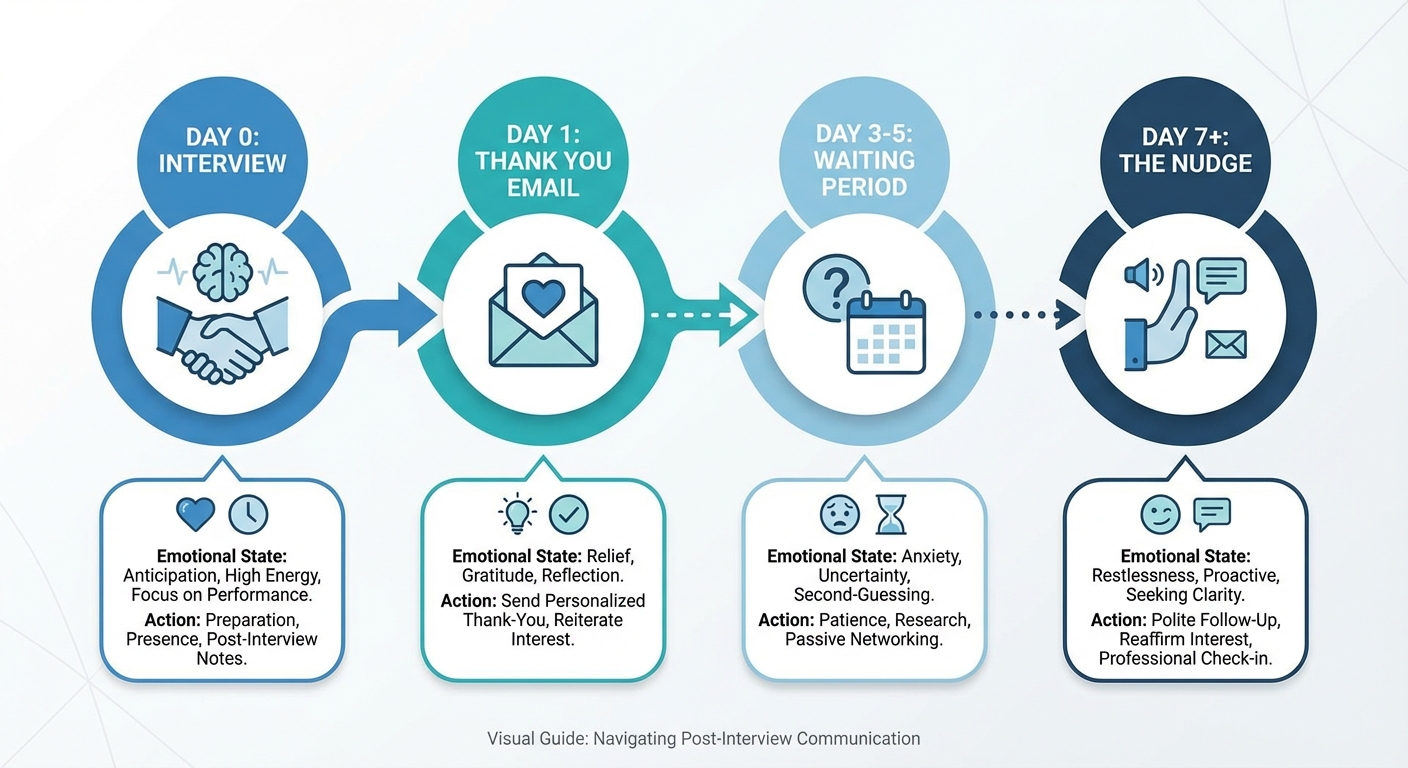
A timeline visual showing 'Day 0: Interview', 'Day 1: Thank You Email', 'Day 3-5: Waiting Period', 'Day 7+: The Nudge', explaining the emotional state vs. necessary action at each stage
What should you actually write in the email?
Keep it brief but impactful. Reference a specific moment from the conversation, reiterate why you fit the role, and confirm you are still interested in moving forward.
Here is where people mess up. They write a novel. No one has time to read a three-paragraph essay on why you love the company culture.
Keep it short. Three sentences are usually enough.
1. Thank them for their time.
2. Mention something specific you discussed.
3. Reiterate enthusiasm.
If you want to stand out, bring up a specific point from the conversation. Maybe you discussed a challenge the team is facing. Perhaps you bonded over a shared software tool. Mention it. This proves you were listening. It proves you weren't just reciting scripted answers.
For example, if you faced a behavioral interview, you likely told stories about your past work. Remind them of that value. "I really enjoyed discussing how my project management experience can help streamline your upcoming launch."
Did you use the STAR method to answer a tough question? Good. Remind them of the result you achieved in that story. Connect the dots for them one last time.
Need help phrasing your skills? You can use our Resume Builder to pull the exact keywords from your resume that match the job description. Consistency helps. If your email matches the tone of your resume, you look like a cohesive package.
For specific templates on what to say, Indeed Career Guide: Follow-Up Email Examples After an Interview has some great starting points. Just don't copy them word-for-word. Make it sound like you.
The Check-In vs. The Thank You
The check-in email is different. This happens a week later. It needs to be even shorter.
- Subject: Following up on our conversation
- Body: "Hi [Name], I'm checking in on the timeline for the [Role Name]. I'm still very interested and available if you need any more info. Thanks!"
That's it. Don't overthink it.
| Follow-Up Type | When to Send | Key Purpose | Tone |
|---|---|---|---|
| The Thank You | 0-24 Hours | Gratitude & Recall | Enthusiastic & Polite |
| The Nudge | 5-7 Days (or post-deadline) | Status Check | Professional & Brief |
| The "Hail Mary" | 14+ Days | Final Closure | Direct & Resigned |
What if they don't reply immediately?
Silence doesn't always mean rejection. Hiring managers get busy, so send one polite nudge after the deadline passes, but move on if you hear nothing after two attempts.
Radio silence. Crickets. It's the worst feeling. You start doubting everything. You replay the video interview in your head. You wonder if your lighting was bad. You wonder if you talked too much.
Stop spiraling.
Truth is, hiring managers are swamped. Our recent data shows 73% of hiring managers admit to missing their own stated deadlines for getting back to candidates. It's usually not malicious. It's just bad time management or internal red tape.
According to Harvard Business Review: How to Follow Up After a Job Interview, there is a fine line between persistence and being annoying. You want to stay on their radar without becoming a nuisance.
The Rule of Three
Send the thank you. Send the check-in. If you still hear nothing after another week, send one final email. If that goes unanswered, let it go.
You cannot force them to hire you. At a certain point, chasing them diminishes your value.
If you find yourself constantly getting ghosted after the phone interview stage, it might be time to look at your application materials again. Sometimes the issue isn't the interview itself. It could be a mismatch that they only realized later.
Run your current CV through our Resume Checker. It helps spot red flags that might be causing hesitation on their end. Maybe you simply need to tweak how you present your skills for the next opportunity.
And look, you researched how to ace an interview. You prepped. You showed up. If they don't get back to you, it's their loss. Keep applying elsewhere.
Key Takeaways
- Speed matters. Send a thank-you note within 24 hours of any interview, even a phone interview.
- Be specific. Reference a topic from the conversation to prove you were engaged.
- Respect the clock. Wait until the deadline passes before sending a status check email.
- Know when to fold. Follow up twice. If there is still silence, move on to the next opportunity.
Don't let the waiting game drive you crazy. Send the email, close the tab, and keep moving forward with OneTwo Resume.