Look, applying for jobs today feels like throwing paper airplanes into a black hole. You spend hours tweaking your bullet points. You hit submit. And then? Silence. Why does this happen? Truth is, a computer read your file first.
Industry keywords are the specific technical skills and job titles that applicant tracking systems require before a human ever reads your application.
And you need to know exactly what those systems want. A well-optimized ATS resume is your golden ticket out of the rejection pile. But knowing you need keywords is only half the battle. You have to know which ones actually matter for your specific field.
Why do industry keywords matter so much?
An ATS scanner works just like a simple search engine. If your application lacks the exact phrases the hiring manager typed in, you get rejected automatically.
The robot gatekeepers
Think about how you search for things online. If you want a black coffee mug, you type in "black coffee mug". You do not type "dark cylindrical drinking vessel". Hiring managers do the exact same thing. They tell the software to find specific terms. If you lack them, you fail. Simple as that.
That is a massive number. You might be perfectly qualified. But the computer doesn't know that. It only knows what it was programmed to look for.
Speaking the right language
Every field speaks a different dialect. A project manager uses different verbs than a graphic designer. To figure out the right terms for your target role, start by checking the U.S. Bureau of Labor Statistics: Occupational Outlook Handbook. It lists common duties and required skills for almost every job out there.
Then you can run your current document through a Resume Checker. This will tell you instantly if you are missing the obvious terms before you actually apply.
What are the top keywords for major industries?
Every field has its own unique vocabulary that algorithms crave. Matching these terms perfectly is the easiest way to guarantee an interview spot.
Tech and Software Development
Tech is obsessed with hard skills. The software wants to see specific languages and methodologies. Words like Agile, Scrum, Python, and AWS are mandatory if they fit your background. Don't just say you coded a website. Name the exact stack — our Python developer resume example shows one named this way.
Healthcare and Medical
Healthcare is heavily regulated. Because of this, certifications matter more than almost anything else. HIPAA compliance, patient care, electronic medical records, and triage are huge. Always spell out your certifications and include the popular acronyms alongside them.
Finance and Accounting
Numbers people need numbers words. Financial modeling, GAAP, risk management, and variance analysis are heavy hitters here. If you want a truly ATS friendly resume in finance, you must show exact software proficiencies like QuickBooks or SAP.
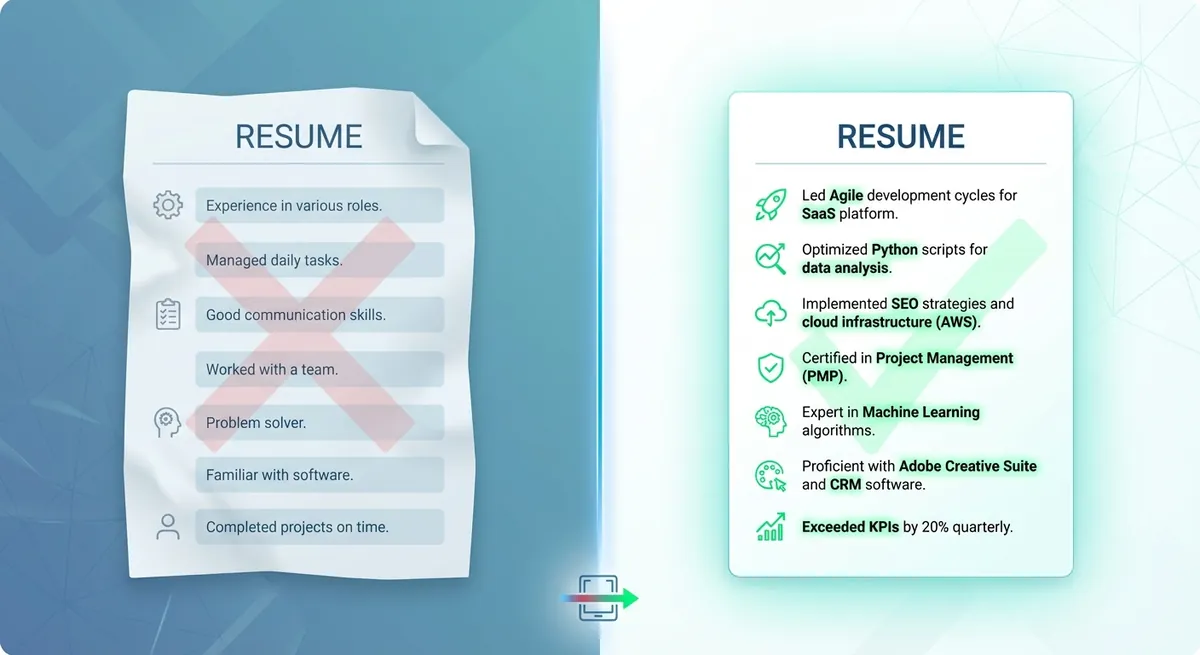
A split-screen visual showing a rejected resume with generic words next to an accepted resume highlighting specific industry keywords in bright green text
Here's a quick breakdown to help you visualize the differences across fields.
| Industry | Core Hard Skill | Core Soft Skill |
|---|---|---|
| Tech | Cloud Computing | Problem Solving |
| Healthcare | Triage | Patient Empathy |
| Finance | Financial Modeling | Analytical Thinking |
| Marketing | SEO Optimization | Cross Functional Collaboration |
How do you naturally add these words to your ATS resume?
Stuffing your document with invisible text or unnatural lists will backfire. You must weave these required terms naturally into your actual work achievements.
Context is everything
Here's the thing. You can't just copy and paste a giant list of words at the bottom of the page in white text. That old trick is totally messed up now. The software catches it immediately.
They will toss your application in the trash even if the computer approved it. You need to build them into your bullet points naturally. If you need help structuring this, a good Resume Builder does the heavy lifting for you. It naturally formats your experience to highlight the important parts without looking fake.
The matching game
Print out the job description. Grab a highlighter. Highlight every skill you see. Those are your keywords. For more detailed strategies on this matching process, the team over at Indeed has a great guide on how to find and use resume keywords.
But remember to only use the ones you actually possess. Lying will get you caught in the interview anyway. Find the exact intersection between your actual experience and the job description. That sweet spot is where you win.
Key Takeaways
- Algorithms control the initial hiring phase for almost every corporate job.
- Always use exact phrases pulled directly from the job description.
- Match your industry's specific vocabulary instead of using generic terms.
- Never stuff keywords unnaturally or use invisible text.
- Prove your skills with context in your bullet points.
Creating an ATS resume doesn't have to be a nightmare. You just need to know the rules of the game. If you're ready to stop getting rejected by robots, try OneTwo Resume today. Get your keywords right and start landing those interviews.