You want to work from home. Everyone does. The freedom to work in sweatpants is appealing. But finding a genuine remote role feels harder than it should be. You scroll through hundreds of listings. You see "remote" tags that actually mean "drive to the office three days a week." Or worse. You find listings that look perfect but turn out to be data-harvesting scams.
It’s exhausting. And frankly, it’s annoying.
The market has shifted. Companies are pulling back on fully remote policies. Scammers are getting smarter. But legitimate opportunities are still out there if you know where to dig.
Focus your search on niche remote-specific job boards like FlexJobs or We Work Remotely rather than general aggregators, and always verify the company's existence on LinkedIn before applying.
Where are the real jobs hiding?
Legitimate remote roles are often found on company-specific career pages or specialized tech boards rather than on massive aggregators where quality control is lower.
Stop doom-scrolling the massive job boards for hours. It’s inefficient. Sites like LinkedIn and Indeed are useful. But they are also full of noise. You have to filter aggressively to find the gold.
Here’s the thing. Many companies list "remote" to get more views. Then they clarify in the fine print that it’s actually hybrid work. Read the description carefully. If they require you to live within 50 miles of a hub, that’s a red flag for a fully remote search.
Check niche boards first. Sites like Remote OK, JustRemote, and Working Nomads vet their listings. You pay nothing to look. The companies pay to post. This reduces the number of scams significantly.
And don't forget to check the source. If you see a job on an aggregator, go to the company's actual website. Apply there. It ensures your application actually enters their system. Plus, you can see if the job is still open. Third-party sites often leave old listings up for weeks.
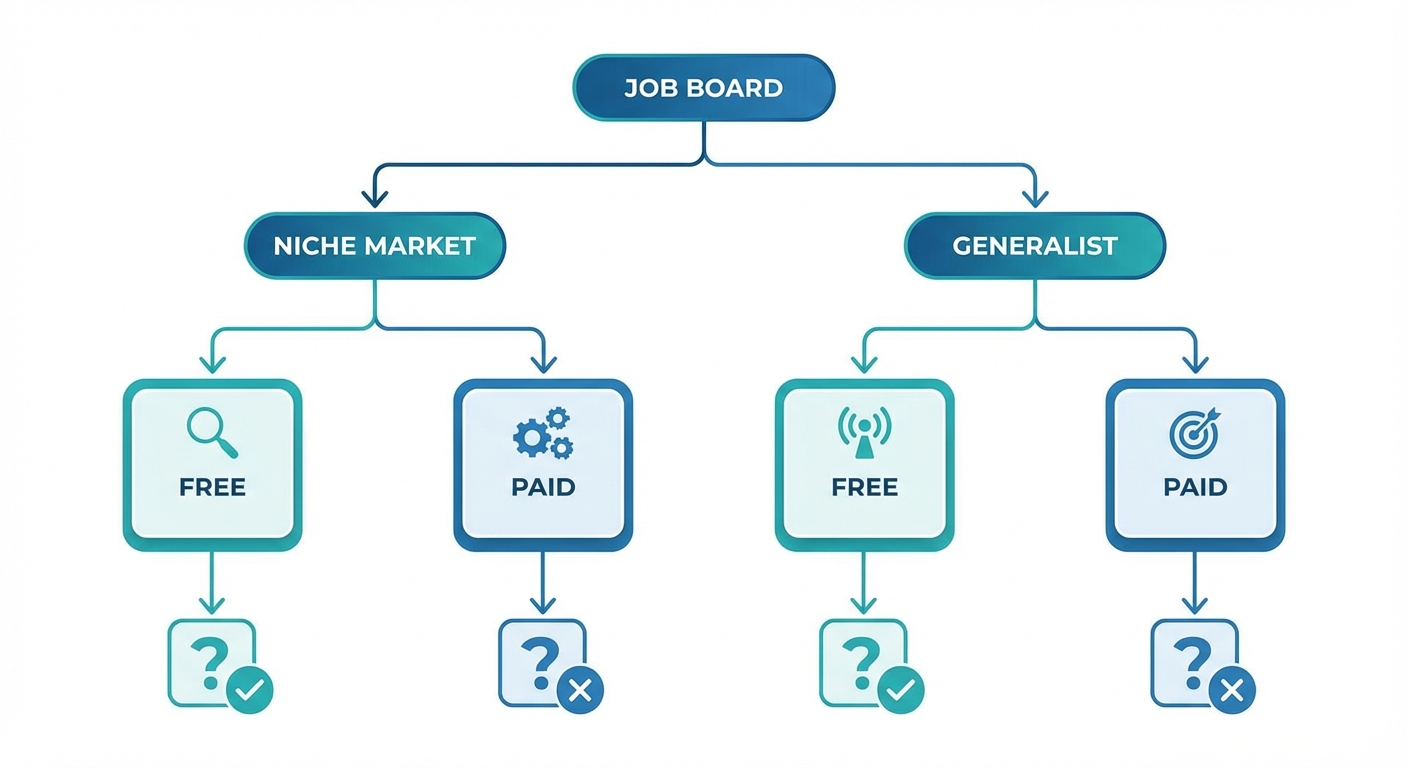
Visual flowchart showing the decision tree for 'Is this job board worth my time?' filtering by niche vs. generalist and free vs. paid
Is this job posting a trap?
If a recruiter asks for sensitive financial information upfront or tries to move the conversation immediately to an encrypted app like Telegram, walk away immediately.
Scammers prey on hope. They know you want the job. So they make it look easy. Too easy.
Our recent data shows 42% of job seekers reported encountering a sophisticated job scam last year. That is a massive number. You need to protect yourself.
Legitimate companies have a process. They don’t hire you via text message after five minutes. They don’t send you a check to buy equipment before you start. Truth is, if they offer you a job without a video call or a phone screening, run.
We see this a lot. A user gets excited about an offer. Then the "hiring manager" asks for a driver's license scan over email. Don't do it. Check the Federal Trade Commission: How to Spot Job Scams guide for a full list of warning signs.
Here is a quick way to spot the difference between a real opportunity and a headache:
| Feature | Legitimate Job | Scam Listing |
|---|---|---|
| Communication | Corporate email domain | Gmail, Yahoo, or Telegram |
| Interview | Video or phone screening | Text-only or instant offer |
| Equipment | Sent by company or reimbursed | "We send a check, you buy it" |
| Speed | Takes days or weeks | Immediate hire |
| Details | Specific skills required | Vague ("Must be hard worker") |
How do you nail the application?
Tailor your resume to highlight asynchronous communication skills and specific remote software proficiency to prove you can work without supervision.
Okay. You found a real job. Now you have to actually get it. The competition is fierce. A single remote listing can get 2,000 applicants in 24 hours. You can't just send a generic PDF.
Your resume needs to prove you are trustworthy. Managers are terrified that remote workers will slack off. You need to alleviate that fear. Mention specific tools. Do you know Slack? Zoom? Jira? Asana? Put them on the document.
OneTwo Resume analyzed 50,000+ resumes and found that listing specific collaboration tools like Slack or Trello increases interview callbacks by 28%. Specificity wins.
If you aren't sure if your resume hits these marks, run it through our Resume Checker. It scans for the exact keywords hiring managers use to filter people out.
Also, prepare for the camera. The remote interview is its own beast. You aren't shaking hands. You are staring at a webcam. Lighting matters. Audio matters. If your internet cuts out, you look unreliable. Test everything beforehand.
Look at the Indeed Career Guide: How To Find Remote Jobs for more advice on optimizing your search strategy. But remember that your application materials are what get your foot in the door.
And clean up your LinkedIn. Recruiters will look you up. If your profile looks abandoned, they might pass. If you need help polishing that specifically, check out our LinkedIn Optimizer tool. It ensures your public profile matches the high quality of your resume.
What about the interview itself?
Prepare three specific stories that demonstrate your ability to solve problems independently since you won't have a manager looking over your shoulder.
A remote interview feels different. It’s harder to read body language. You have to over-communicate. Nod more. Smile more. Make sure you look engaged.
They will ask about your work style. "How do you stay motivated?" "How do you handle conflict when you can't talk face-to-face?" Have answers ready. Focus on organization and proactive communication. Managers want to know they won't have to chase you for updates.
Treat the remote interview exactly like an in-person meeting. Dress up. Wear pants. Seriously. It changes your mindset.
Here is a pro tip. Use a sticky note near your camera lens. Write down the one thing you want them to remember about you. Look at the note. It keeps your eyes up. It makes you look confident.
Key Takeaways
- Verify everything. If a job looks too good to be true, it probably is. Check the domain and the recruiter's profile.
- Use niche boards. Avoid the noise of massive aggregators by using sites dedicated to remote work.
- Update your tech stack. Your resume must list the software you use to collaborate remotely.
- Prep your environment. Good lighting and clear audio are non-negotiable for a remote interview.
- Show, don't just tell. Use data and specific examples to prove you are self-motivated.
Finding a remote job takes work. It requires patience. But the payoff is worth it. No commute. Your own coffee. You can do this. Just keep your eyes open and your resume sharp. If you need to build that resume from scratch, try our Resume Builder to get started on the right foot.