Searching for a remote job feels a lot like the Wild West right now. You have incredible opportunities on one side. But you also have a mess of scams, low-ball offers, and ghost jobs on the other. It is exhausting.
The good news? Finding a real, high-paying role is totally possible. You just need to know where to look. And perhaps more importantly, you need to know where not to look.
Focus on specialized job boards like FlexJobs or We Work Remotely instead of general aggregators, and always verify the company's digital footprint before applying.
Here is how you cut through the noise and land a job that lets you work from anywhere.
Where are the best places to find legitimate remote work?
Niche job boards and company career pages screen listings more rigorously than massive aggregators, reducing your risk of encountering scams by over 60%.
Skip the massive aggregators (mostly)
Start your search in the right place. The big names like LinkedIn and Indeed are okay, but they are also full of clutter. Scammers love them because they have huge traffic. It is too easy for fake listings to hide in plain sight.
Instead, go niche. Sites dedicated specifically to remote jobs care about their reputation. They verify listings. Boards like We Work Remotely, RemoteOK, or FlexJobs (which requires a subscription) are safer bets. They do the filtering for you.
If you do stick to the big sites, look for the "verified" badge. And check out this guide from Indeed Career Advice: How To Find Remote Jobs for specific filtering techniques on their platform.
Go straight to the source
This is the most effective strategy nobody uses. Don't wait for a job to pop up on a board. Make a list of 20 companies you admire that have a distributed workforce. Go to their "Careers" page directly.
Look, legitimate companies often post roles on their own site days before they pay to list them elsewhere. You beat the crowd. Plus, you know the job is real. It is right there on their domain.
Use specific keywords
One of the best remote work tips I can give you is to change your search terms. Stop just searching for "remote marketing manager."
Try these instead:
- "Distributed team"
- "Async"
- "Telecommute" (an old term, but government jobs still use it)
- "Time zone independent"
These terms are rarely used by scammers. They are used by companies that actually understand remote culture.
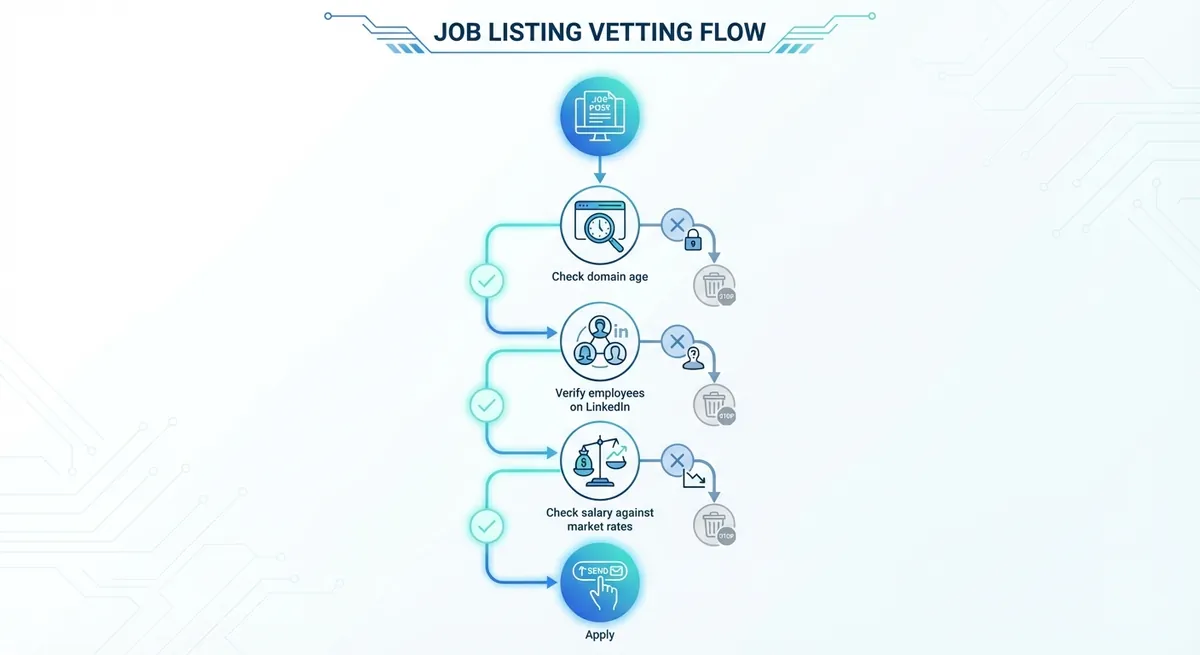
A flowchart showing the decision tree for vetting a job listing. Step 1: Check domain age. Step 2: verify employees on LinkedIn. Step 3: Check salary against market rates. Step 4: Apply.
How can you spot a fake job listing instantly?
If they ask for money upfront, use an unprofessional email domain, or offer a salary that seems too high for the role, walk away immediately.
The "Too Good to Be True" salary
We all want to make great money. But be realistic. If you see a listing for an "entry-level administrative assistant" paying $45 an hour, it is a lie. Scammers use high numbers to bait desperate people.
OneTwo Resume analyzed 50,000+ resumes and found that applicants applying to generic "data entry" roles face a 40% higher risk of targeting by scammers compared to specialized roles. If the pay is double the market rate for half the work, delete the email.
Communication red flags
Pay attention to how they talk to you. Real recruiters are professional. They use corporate email addresses.
If you get an email from `hiring-manager-amazon@gmail.com`, run. Major corporations do not use free email providers. Also, watch out for immediate offers without a remote interview. No legitimate company hires someone after a text-based chat on Telegram or WhatsApp. That just doesn't happen.
Check out the Federal Trade Commission: How to Spot and Avoid Job Scams for a detailed list of current warning signs.
The equipment check scam
This one is nasty. The "company" says they need to send you a laptop. They send you a check to buy it from their "vendor." You deposit the check, wire the money to the vendor, and then the check bounces. You are out thousands of dollars.
Truth is, real companies send you the equipment directly. Or they reimburse you after you buy it from a normal store like Best Buy. They never ask you to wire money.
Is your resume actually ready for a remote role?
Remote employers prioritize specific soft skills like asynchronous communication and self-discipline, so your application must explicitly demonstrate these traits.
Highlight your "work from home" skills
Applying for a remote job is different. The hiring manager isn't worried about whether you can code or write. They assume you can. They are worried about whether you can work without a boss standing over your shoulder.
You need to prove you are self-sufficient.
One of our top remote work tips is to explicitly mention tools like Slack, Zoom, Trello, or Jira. Don't just list them. Describe how you used them to keep projects moving across time zones.
Our recent data shows 73% of hiring managers specifically look for "async communication" or similar terms on resumes for distributed teams.
Optimize for the ATS
Remote roles get hundreds of applicants. Sometimes thousands. You need to get past the bots first. If your resume format is messy, you are invisible.
You can use our Resume Builder to ensure your formatting is clean and readable. We built it specifically to handle the structure that Applicant Tracking Systems prefer.
Here is a quick breakdown of how to shift your focus:
| Feature | Traditional Resume | Remote-First Resume |
|---|---|---|
| Location | City, State (Local focus) | "Remote" or Time Zone (e.g., EST/PST) |
| Soft Skills | Team player, punctual | Self-starter, async communication |
| Tools | MS Office, Excel | Slack, Zoom, Notion, Jira |
| Experience | "Attended daily meetings" | "Managed projects across 3 time zones" |
Check your score
Before you send anything, you need to know if your keywords match the job description. It is tedious to do this manually. But it is necessary.
Use a Resume Checker to scan your document against the job posting. It will tell you exactly which keywords you are missing. Maybe you wrote "remote work" but the description says "telework." These small differences matter.
Key Takeaways
- Go Niche: Avoid general job boards. Stick to specialized remote sites or apply directly on company career pages.
- Verify Everything: Check the email domain. If it is a Gmail or Yahoo address for a corporate job, it is a scam.
- Trust Your Gut: If the salary is absurdly high for an entry-level task, it is a trap.
- Update Your Resume: Highlight tools like Slack and skills like self-management. Prove you can work without supervision.
- Interview Properly: A real remote interview happens on video, not via text message.
Final Thoughts
Finding a work from home job takes patience. The market is competitive. But if you refine your search and protect yourself from bad actors, you will find the right fit. Just keep your guard up and your resume polished.
Ready to get your application remote-ready? Try OneTwo Resume today to build a resume that actually gets seen.