Walking into an interview room is nerve-wracking enough. But walking in when you are trying to convince someone to hire you for a job you have never technically done before? That is a whole different level of stress. You worry they see you as a risk. You worry you look flighty.
But here is the truth. The job market has changed. Staying in one lane for forty years is the exception now, not the rule. Employers know this.
Your job isn't to apologize for your past. It is to explain why your past makes you dangerous, in a good way, for the future. Let’s look at how to handle this conversation.
Frame your pivot as a deliberate journey where your past experiences provided the necessary tools to succeed in this specific new role.
Why do hiring managers actually care about your switch?
They are not looking for flaws in your history. They simply want to verify that you have the grit to learn a new trade and the transferable skills to survive the ramp-up period.
It’s about risk mitigation
Put yourself in their shoes for a second. Hiring is expensive. When they see a resume that takes a sharp left turn from sales to software engineering, or from teaching to project management, they have one question. "Will this person stick it out when things get hard?"
They don't care about your soul-searching journey. They care about their bottom line. You need to show them that this isn't a whim. It is a calculated move.
The data is on your side
Here is something interesting. We looked at the numbers.
This means the "what" matters less than the "how" and the "result." If you can prove you solve problems, the title you held while doing it becomes secondary.
Don't let your resume contradict you
Before you even step into the room (or Zoom call), your paperwork needs to tell the same story your mouth will. If your resume screams "Accountant" but you are applying for "Creative Director," you have already confused them. You need to audit your application materials.
Use a good Resume Checker to scan your document. It helps you see if the keywords and skills you are emphasizing actually align with the new role you want. Consistency builds trust.
How do you structure your answer?
Connect the dots for them by using the Present-Past-Future model to explain where you are, what you learned before, and why this role is the only logical next step.
The "Connect the Dots" technique
When they say, "Walk me through your resume," or "Why the switch?" do not give them a chronological history of your life. That is boring. And it highlights the lack of experience in the new field.
Instead, start with the common thread.
Identify the one thing you loved in your old job that exists in the new job. Maybe you were a nurse who loved the fast-paced triage. Now you want to work in Agile product management. The thread is "prioritizing critical needs under pressure."
Make that the headline. Then fill in the details.
Comparison: Weak vs. Strong Answers
Look at the difference between apologizing and owning your narrative.
| Feature | The "Apologetic" Answer (Weak) | The "Strategic" Answer (Strong) |
|---|---|---|
| Focus | Focuses on what they hated about the old job. | Focuses on the skills they are bringing forward. |
| Tone | Unsure, defensive, or negative. | Confident, forward-looking, and excited. |
| Gap | Highlights the lack of specific experience. | Highlights the unique perspective they offer. |
| Why | "I just needed a change." | "I realized my strongest asset was X, which is central to this role." |
External validation helps
Experts agree that narrative control is everything. According to the Harvard Business Review - How to Explain Your Career Transition, you must craft a coherent story that explains the leap. If you don't provide the logic, they will invent their own. usually incorrect. reasons for your move.
What skills matter most when you're starting over?
Your technical knowledge might be new, but your soft skills are veteran-level. Lean heavily on communication, project management, and adaptability to bridge the gap.
The power of "Transferable Skills"
This is the buzzword everyone uses. But few people use it right. Transferable skills are not just generic terms like "hard worker." They are specific competencies that function the same way regardless of the industry.
If you are pivoting, you are not a rookie. You are a professional in a new context.
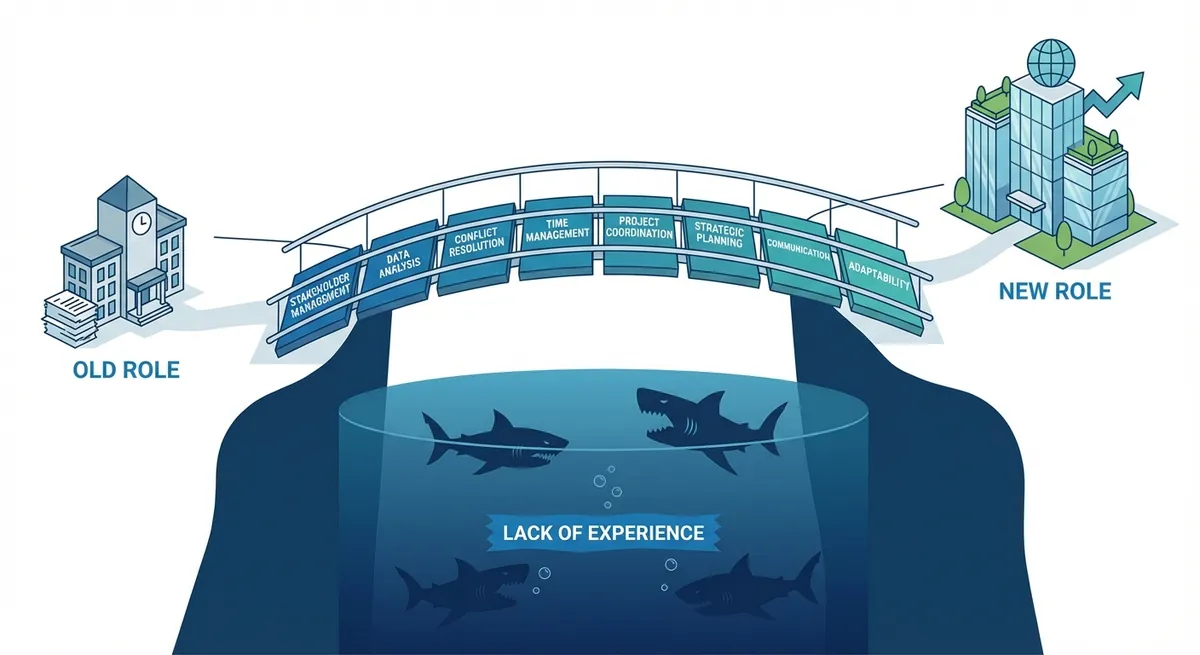
A visual bridge connecting 'Old Role' on the left to 'New Role' on the right. The planks of the bridge are labeled with skills like 'Stakeholder Management', 'Data Analysis', 'Conflict Resolution', and 'Time Management'. Underneath the bridge, a shark tank labeled 'Lack of Experience'.
Identifying your weapons
Sit down and list everything you did daily. Not the tasks. The mechanisms. Did you calm down angry customers? That is "Crisis Negotiation" or "Client Success." Did you organize the office filing system? That is "Process Optimization."
If you are struggling to identify these, you might need to rewrite your document from scratch. Our Resume Builder has built-in suggestions that help you rephrase old duties into modern, versatile skill sets.
The "Career Transition" vocabulary
A successful career transition relies on speaking the language of the new tribe. If you are moving into tech, stop saying "I managed the schedule." Start saying "I managed the sprint workflow." It’s the same thing. But the second one proves you belong.
How do you handle the skepticism?
Confidence kills doubt faster than credentials do. Acknowledge the learning curve immediately and provide a concrete plan for how you intend to close that gap.
Address the elephant in the room
Don't wait for them to ask if you can handle the learning curve. Bring it up first. Say something like, "I know I don't have ten years of Python experience like a traditional candidate. But here is my plan to get up to speed in the first 90 days."
This shows self-awareness. It shows drive.
The "Overqualified" Trap
Sometimes the problem isn't that you don't know enough. It's that you know too much about something else. They might fear you will get bored. Or that you are too expensive.
Address this by focusing on "mission." You aren't stepping down. You are stepping in to a role that aligns with your values. For more specific scripts on this, check out Indeed Career Advice - Interview Questions and Answers for Changing Careers. They break down how to frame salary expectations during a shift.
Handling the "Why now?" question
This is the classic career pivot question. Why now? Why not five years ago? Why not five years from now?
Your answer should be about convergence. "I've spent the last few years gathering the skills in X and Y. I realized that the market is moving toward Z, and I am now perfectly positioned to ride that wave."
Make it sound like destiny. Not desperation.
Key Takeaways
- Own the narrative: Don't let the interviewer guess why you are switching. Tell them a clear, positive story.
- Connect the dots: Find the common thread between your old job and the new one. Make it the hero of your story.
- Use the right words: Translate your past experience into the language of your new industry.
- Be proactive: Address the gaps in your resume before they do, and have a plan to fix them.
- Audit your resume: Ensure your written application matches your verbal explanation.
Changing careers is brave. It takes guts to walk away from what you know. But with the right preparation, you can turn that career change anxiety into your greatest selling point.
Ready to get that story straight on paper? Use OneTwo Resume to build a CV that highlights your potential, not just your history.