Updated September 27, 2026.
In short: to change careers without starting over, keep as much of your existing experience as possible and change one thing at a time. Target a bridge role that reuses about half of your current skills, rewrite your resume in the new field's language, fill only the one or two gaps job ads actually name with a short credential, and look for an internal move or a referral before you cold-apply. Done that way, you can often keep your seniority and avoid a large pay cut; a full restart is usually a choice, not a requirement.
How do you change careers without starting over?
The short answer: you change careers without starting over by carrying your seniority with you instead of resetting it. In practice that means four mechanisms, usually combined: transferable-skills mapping (rewrite what you already do in the target field's language — budgets, stakeholders, deadlines and results translate almost everywhere), a bridge role (a job that reuses about half of your current skills while you learn the other half on the payroll), an internal pivot (switch functions inside your current employer, where your reputation substitutes for missing credentials), and a credential bridge (a certificate or portfolio that fills the one or two specific gaps the job ads actually name — not a second degree).
The test for each option is simple: how much of your last five years still counts. Here is how a true restart compares with a planned pivot:
| Starting over | Pivoting without starting over | |
|---|---|---|
| Typical first title | Entry level / junior | Mid level "bridge" role |
| Timeline to first offer | Often 12+ months (retraining first) | Roughly 3–9 months while still employed |
| Pay in year one | Large cut is the norm | Flat to modest cut, recoverable within a cycle |
| What you keep | Little — you compete with graduates | Domain knowledge, network, work habits, references |
| Retraining needed | A full program before you can apply | One targeted credential, learned alongside the job |
Everything below unpacks these steps in order: proof of qualification, the pay question, where to look, and a 90-day plan with three worked examples.
Is it too late to switch careers?
No. Changing jobs and fields is normal across the whole working life, not just in your twenties. The U.S. Bureau of Labor Statistics' employee tenure release (September 24, 2026) puts median time with a current employer at 4.1 years in January 2026, which means the typical career is a series of moves, not one long climb.
Hiring managers care about whether you can do the job in front of them. Experience in another field is an asset when you present it as evidence of the same underlying abilities: solving problems, handling people, delivering on deadlines. Ten years solving problems in retail operations is ten years of evidence for an operations role in tech.
What does change with age or seniority is the strategy. You can't throw your old resume at a new industry and hope. You need to rebuild the narrative around what your new manager actually needs, which is what the rest of this guide is for. If you're weighing the move later in your career specifically, we cover the extra considerations in how to make a career change later in life.
How long does a career change take?
Plan for three to nine months from decision to offer for a bridge role, and one to two years if the new field requires a credential you don't have yet. The biggest variable isn't the market; it's how close your target role is to what you already do.
| Type of move | Example | Typical time to first role | What makes it faster |
|---|---|---|---|
| Same function, new industry | Marketing manager, retail → marketing manager, healthcare | 1–3 months | Industry vocabulary, one relevant project |
| New function, same industry | Nurse → clinical informatics analyst | 3–6 months | A bridge role that reuses domain knowledge |
| New function, new industry | Teacher → corporate learning designer | 6–12 months | Portfolio pieces, referrals, a short certificate |
| Licensed or credentialed field | Analyst → registered nurse, paralegal → attorney | 1–4 years | Accelerated programs, working in an adjacent role while studying |
The first row is barely a career change; the last is a genuine restart. Most people who say "I want to change careers" are in the middle two rows, and those are the moves this guide is built for. A full week-by-week version is in how long a career change takes and the 90-day plan.
How do I prove I'm qualified?
By connecting the dots for the recruiter, because they won't do it for you. Most career changers fail here: they list what they did, not why it matters to the new role.
To bridge the gap, identify your transferable skills, the abilities that travel with you: communication, project management, budgeting, data analysis, leadership, client handling. Then translate every line of your history into the language of the target job.
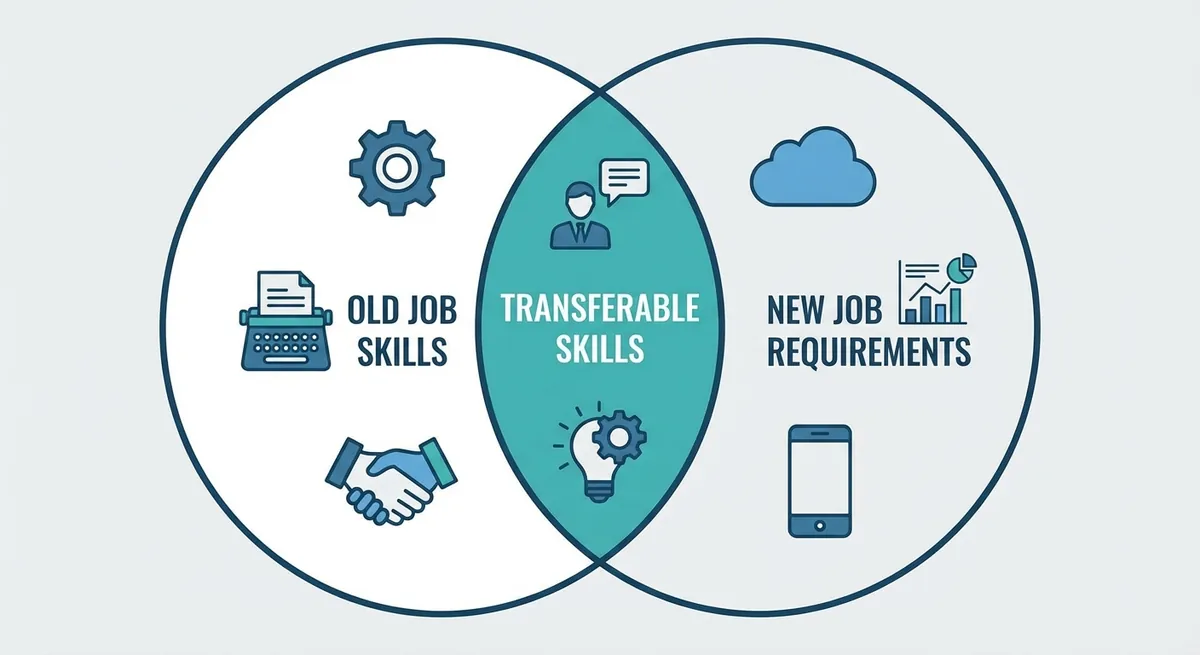
A Venn diagram showing 'Old Job Skills' on the left, 'New Job Requirements' on the right, and 'Transferable Skills' in the overlapping center, with icons for soft skills like leadership and communication
Hiring managers are busy and spend seconds on a first scan. If they have to guess how your experience as a teacher applies to corporate training, they move on. Use the Occupational Outlook Handbook or O*NET to read exactly what the target role requires, then map your history onto it.
| Old-industry phrasing | The universal translation | The new-industry value |
|---|---|---|
| Managed a classroom of 30 students | Managed large groups and facilitated learning | Corporate training and development |
| Handled customer complaints at the front desk | Conflict resolution and client retention | Customer success management |
| Wrote weekly reports for the shift supervisor | Data analysis and performance reporting | Business operations |
| Ran the unit's medication reconciliation audit | Process improvement and compliance auditing | Quality or clinical informatics |
| Scheduled 20 staff across three shifts | Resource planning and workforce scheduling | Operations coordination |
| Coordinated vendor deliveries for a restaurant | Supplier management and logistics | Supply chain or procurement |
You aren't lying. You're translating. For a deeper method, see identifying transferable skills for a career change.
Can you change careers without a degree?
Yes, in more fields than most people assume. Sales, customer success, project coordination, IT support, UX research operations, digital marketing, bookkeeping and most skilled trades hire on demonstrated skill, certifications and referrals rather than a specific degree. The exceptions are licensed professions (nursing, law, engineering roles that require a PE, K-12 teaching in most states), where the credential is the gate.
The practical route is the same as everywhere else in this guide: pick a bridge role, get a short credential that the job postings actually name, and build one or two portfolio pieces. We break down field-by-field options in how to change careers without a degree.
Will I have to take a pay cut?
Sometimes, but usually less than you fear, and it's often avoidable. A pay cut comes from restarting at the bottom of a new ladder. A bridge role, one that sits between your old field and your new one, lets you carry seniority across.
- Same function, new industry: rarely a cut; you're selling the same skill to a new buyer.
- New function, same industry: often a lateral move because your domain knowledge is worth something.
- New function, new industry: the real risk. Offset it by targeting roles one level below your current title in the new field, then moving up quickly once you have a track record.
- Credentialed field: expect a temporary cut while you train; plan the finances before you resign.
Negotiate on what you bring, not on your old salary. A changer who can point to "I ran a $2M budget" has a stronger anchor than one who says "I used to earn $X."
Where should I start looking?
Conversations and referrals often surface roles before they reach job boards, so start there. Mass-applying on big boards is hardest for changers, because a resume screened for exact job titles undersells an unconventional history.
Start on LinkedIn, but don't just add people. Find people doing the job you want, ask how they got there, and ask what they'd want to see from someone in your position. Most people are generous with this. If your profile still describes your old career, fix it first with the LinkedIn optimizer so your headline reads "future role" rather than "past history."
What if my resume looks disjointed?
Use a hybrid format. A standard chronological resume emphasizes where you were, not where you're going, and for a changer that hurts. A hybrid puts a "Core Competencies" or "Key Skills" section at the top, packed with your transferable skills matched to the job description, and keeps a compact chronological history below it so the reader still sees stability.
Don't ignore the applicant tracking system, either. It scans for keywords, and a changer's resume often has the right skills under the wrong names. Run it through the resume checker against the posting, and rewrite duties as outcomes with the bullet point rewriter: "cut processing time by 20%" proves you can do the job regardless of industry. The full layout is in the hybrid resume strategy and resume tips for career changers.
Three worked examples
These are illustrative composites, not case studies of real people.
Teacher → learning and development specialist
A high-school teacher wants out of the classroom. The bridge role is instructional design or corporate L&D: same core skill (designing and delivering learning), new audience. Over 90 days they rebuild two lesson units as e-learning modules in a free authoring tool, add "curriculum design," "learning outcomes" and "facilitation" to their resume, and reach out to L&D managers at three local companies. The first offer is a training coordinator role at roughly the same pay, with a path to instructional designer.
Nurse → clinical informatics analyst
An RN with six years on the floor is burned out on shifts but doesn't want to waste the clinical knowledge. The bridge is clinical informatics: hospitals need people who understand both the workflow and the EHR. They volunteer as the unit's super-user for the next EHR update, take a short informatics certificate, and apply internally first. Same employer, no pay cut, no nights.
Retail store manager → SaaS sales
A store manager runs a team of fifteen and a P&L. The bridge is a sales development or account management role at a software company, where team leadership, targets and customer handling all transfer. They rewrite the resume around revenue numbers ("grew store revenue 18% year over year," "top-quartile in district on conversion"), get a referral from a former colleague now in tech, and land an account executive role in four months.
How to explain the change in interviews
Every interviewer will ask why. Have a two-sentence answer that points forward, not backward: what you're moving toward and what evidence you have that you'll be good at it. Never lead with what you're escaping. The full set of scripts is in how to explain a career change in interviews.
Key takeaways
- Don't start from zero. Target a bridge role that reuses half your skills and carries your seniority across.
- Plan on three to nine months for most moves, longer only if a license or degree is the gate.
- Translate, don't list. Rewrite every bullet in the new field's language and lead with outcomes.
- Network over apply. Referrals beat cold applications, especially for unconventional histories.
- Reformat. A hybrid resume puts transferable skills at the top and keeps the history visible.
- Protect your pay by moving one level at a time rather than restarting the ladder.
Changing careers is a marathon, not a sprint, but it's a marathon you can plan. When you're ready to rebuild the resume for the move, the resume builder can rewrite your existing bullets for the new role, and resume summary examples for career changers show how to open the page.