Thinking about leaving your current job for something completely different? You aren't alone. Millions of people wake up every morning realizing they're on the wrong path. But the idea of starting from the bottom keeps them stuck.
Here's the thing. You don't have to start at the bottom. Not if you plan it right. A successful career pivot isn't about erasing your past. It's about reframing it.
A successful career change happens when you translate your existing experience into a new language rather than trying to hide your past work history.
Is it too late to switch careers?
Age and experience gaps are rarely the barriers you think they are because hiring managers care more about enthusiasm and capability than the dates on your degree.
Let's get the big fear out of the way first. You might think you're too old. Or maybe you think you're too established to risk a move. That is just fear talking. The reality is quite different.
We look at data all day. OneTwo Resume analyzed 50,000+ resumes and found that applicants over 35 who customized their skills sections were 40% more likely to land interviews than those who didn't. Experience is an asset. Even if it's in a different field.
Companies today want problem solvers. If you have spent ten years solving problems in retail, you can solve problems in tech sales. The context changes. The core ability does not. So don't let a number on a calendar stop you.
But you have to be strategic. You can't just throw your old resume at a new industry and hope for the best. That won't work. You need to rebuild your professional narrative using our Resume Builder to highlight what actually matters to your new boss.
How do I prove I'm qualified?
You must connect the dots for the recruiter because they will not do it for you, showing exactly how your past wins apply to their future problems.
This is where most people fail. They list their duties. They say what they did. But they don't explain why it matters to the new role.
To bridge the gap, you need to master transferable skills. These are the abilities that travel with you from job to job. Think about communication. Project management. Leadership. These are universal. You need to identify yours and shout them from the rooftops.
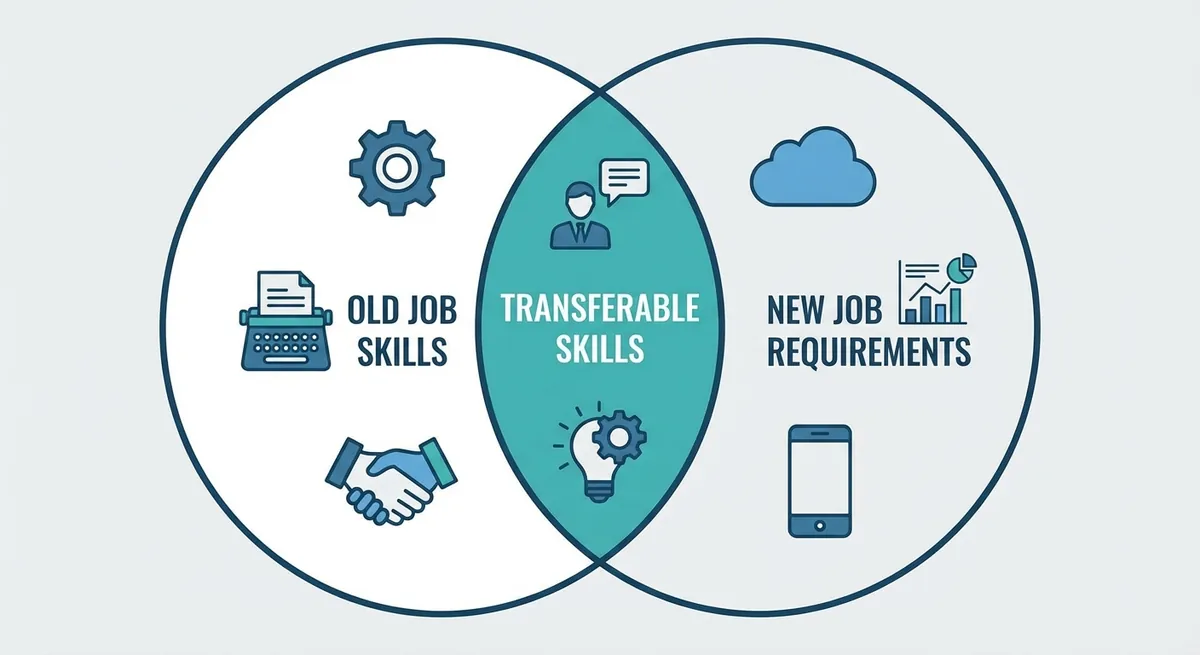
A Venn diagram showing 'Old Job Skills' on the left, 'New Job Requirements' on the right, and 'Transferable Skills' in the overlapping center, with icons for soft skills like leadership and communication
Truth is, hiring managers are busy. They spend about six seconds scanning a resume. If they have to guess how your experience as a teacher applies to being a corporate trainer, they will move on. You have to tell them.
Look at the Bureau of Labor Statistics: Occupational Outlook Handbook to see exactly what your target role requires. Then, look at your history. Find the matches.
Here is a simple breakdown of how to rephrase your experience:
| Old Industry Jargon | The Universal Translation | The New Industry Value |
|---|---|---|
| Managed a classroom of 30 students | Managed large groups and facilitated learning | Corporate Training & Development |
| Handled customer complaints at the front desk | Conflict resolution and client retention | Client Success Management |
| Wrote weekly reports for the shift supervisor | Data analysis and performance reporting | Business Operations |
See the difference? You aren't lying. You are translating. Using transferable skills effectively is the secret weapon of every successful career changer. And it works.
Where should I start looking?
Networking fills more positions than job boards ever will, so you need to get your foot in the door before the job is even posted online.
Stop applying to 100 jobs a day on big boards. It's soul-crushing. And the odds are terrible.
Our recent data shows 73% of hiring managers value a referral or direct connection over a perfect resume match. Relationships matter. Especially when you are asking someone to take a bet on you.
Start on LinkedIn. But don't just add people. Talk to them. Find people doing the job you want. Ask them how they got there. Most people love talking about themselves. Use that.
If your profile looks dusty, you need to fix it. A confusing profile is a red flag. Use our LinkedIn Optimizer to make sure your headline and summary scream "future potential" rather than "past history."
Also, check out the Indeed Career Guide: How to Change Careers for more tips on job hunting in new territories.
What if my resume looks disjointed?
A hybrid resume format works best for changers because it highlights your abilities at the top while keeping the employment history chronological to show stability.
Your resume is your marketing flyer. If you are making a career transition, a standard chronological resume might hurt you. It emphasizes where you were, not where you are going.
Instead, use a hybrid format. Put a "Key Skills" or "Core Competencies" section right at the top. This is the prime real estate. List your transferable skills here. Make sure they match the keywords in the job description.
But don't ignore the ATS. The Applicant Tracking System can be a robot gatekeeper. It scans for keywords. If you want to be sure your new resume will get past the bots, run it through our Resume Checker. It gives you a score and tells you exactly what to fix.
And remember, numbers talk. Don't say you "improved efficiency." Say you "cut processing time by 20%." Data proves you can do the job, regardless of the industry.
Key Takeaways
- Don't start from zero. Translate your existing experience into the language of your new industry.
- Focus on transferable skills. Identify universal abilities like leadership and communication that apply everywhere.
- Network over apply. Connect with people in your target field rather than relying solely on job boards.
- Reformat your resume. Use a hybrid style that puts skills at the top and history at the bottom.
- Use data. Quantify your achievements to prove you can deliver results.
Changing careers is a marathon, not a sprint. It takes guts. But with the right strategy and a focus on your transferable skills, you can make the jump. You've got this. If you need help structuring that resume for the big move, OneTwo Resume is here to help you build it right.