You feel a pit in your stomach just thinking about it. Walking into your boss’s office. asking for more money. It is awkward. It is scary. But it is also absolutely necessary if you want to grow your career. Most people stay in the same salary bracket for years simply because they are afraid to have the conversation.
Here is the truth. Your manager isn't going to wake up one morning and decide to pay you more just because you're nice. You have to ask.
Schedule a formal meeting specifically for this topic, come prepared with a list of quantified achievements from the last year, and propose a specific number based on current market data.
When is the right time to make your move?
The best window to ask is 3-4 months before your annual review or immediately following a significant project win that directly generated revenue or saved time.
Timing is everything. If you wait until your annual review to ask for a raise, you are likely too late. By that point, the budget is usually set in stone. The money has been allocated. And you are left with whatever 3% cost-of-living adjustment they planned for you.
Read the Room
Look around. Is the company laying people off? Did they just lose a major client? If so, keep your head down. But if the company just closed a massive deal or you just delivered a project under budget, strike now.
Do Your Homework
Don't pull a number out of thin air. You need hard data. Research salary expectations for your specific role in your specific city. You can check resources like the Bureau of Labor Statistics: Occupational Outlook Handbook to see where your industry is heading. If you are being paid 20% below market rate, that is your strongest argument.
What should you actually say in the meeting?
Frame your request around the value you bring to the company and the future ROI they can expect, rather than your personal financial needs or tenure.
This is where most people mess up. They make it personal. They talk about their rent going up. Or how long they have been there. Truth is, your boss doesn't care about your rent. They care about the business.
The "Receipts" Method
You need proof. You need to show exactly how you have made the company better. Did you streamline a process? Did you bring in sales? Write it down.
If you struggle to remember what you did six months ago, you are not alone. It helps to keep a "brag sheet" throughout the year. You can even use our Resume Builder to draft these bullet points. It helps you articulate your wins clearly. Then you just repurpose them for your meeting script.
Knowing How to Negotiate Salary
When you finally ask for a raise, be specific. Don't say "I'd like a bump in pay." Say, "Based on my performance and market research, I am looking for a salary adjustment to $85,000."
Here is a breakdown of how to frame your arguments:
| Weak Argument | Strong Argument |
|---|---|
| "I've been here for two years." | "In the last year, I increased output by 15%." |
| "My rent has gone up." | "The market rate for this role is $10k higher." |
| "I work really hard." | "I managed the project that secured our biggest client." |
| "I need more money." | "I am operating at a Senior level and want to align my comp." |
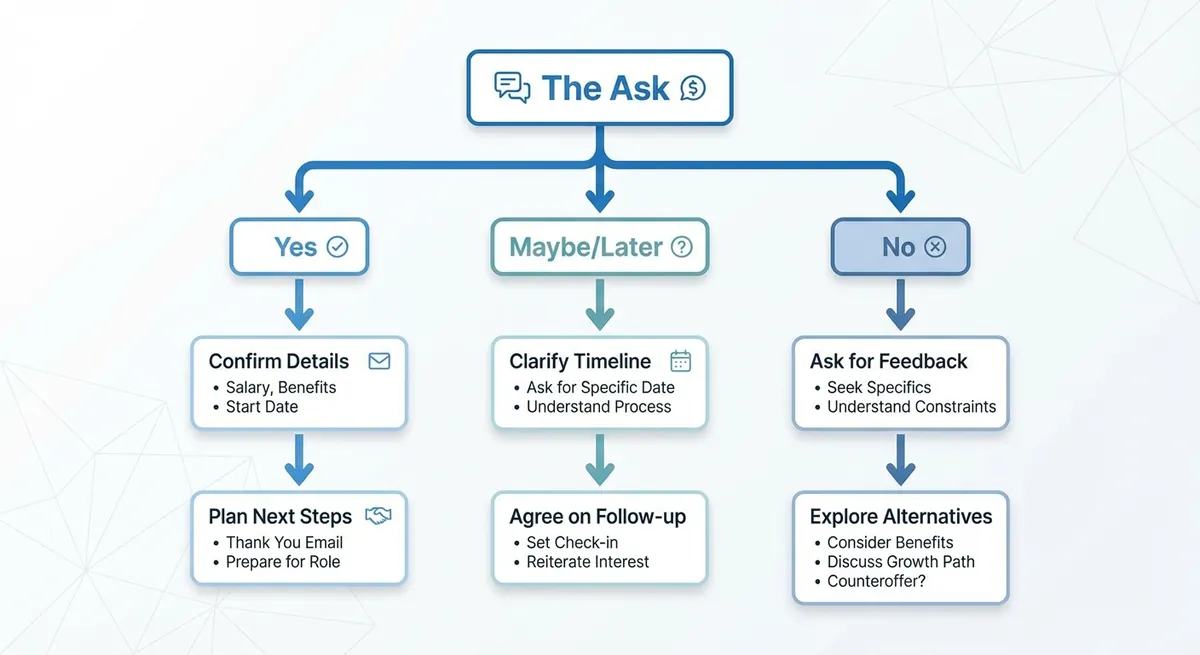
A flowchart showing the decision tree of a salary negotiation conversation, starting with 'The Ask' and branching into 'Yes', 'Maybe/Later', and 'No' with response strategies for each
What if they say no or want to negotiate?
If the answer is no, do not get emotional; instead, ask for a specific timeline to revisit the conversation and clear metrics on what you need to achieve to get that "yes."
Getting a "no" stings. But it isn't the end of the road. It is often just the start of the negotiation.
The Counter-Move
Sometimes they can't match the money. That is okay. This is where you pivot to benefits. Can you get more vacation days? Better remote work flexibility? A title change?
Job offer negotiation works similarly. If you have another offer on the table, you have leverage. But be careful. You don't want to sound like you are holding them hostage.
When to Walk Away
If they say no and give you no path forward, listen to them. They are showing you your future there. It might be time to polish up your profile. You can use our Resume Checker to see how your current resume stacks up against the competition before you start applying.
And for a deeper dive on the psychology of the ask, this guide from Harvard Business Review: How to Ask for a Raise offers some excellent strategies on framing your request.
Key Takeaways
- Timing is critical. Don't wait for the annual review. Ask after a win.
- Bring data. Use specific numbers to back up your request.
- Keep it professional. Focus on business value, not personal expenses.
- Have a Plan B. Be ready to negotiate for benefits if the budget is tight.
Preparation is the antidote to anxiety. Go get what you earned.