Let's be honest. Talking about money makes most of us sweat. But avoiding the conversation entirely costs you thousands of dollars over the course of your career.
Truth is, your manager won't usually hand you more cash just because you showed up and did your job. You have to step up and make a compelling case for yourself. It feels terrifying. It really doesn't have to be.
Asking for a pay increase requires documented proof of your value, knowing market rates, and timing your request when the company thrives.
Look, inflation is real. The cost of living keeps creeping up. But your boss does not care about your rent or your grocery bill. They care about business impact. If you want a bigger paycheck, you need to prove you are generating more value than you were the day you got hired.
Here is exactly how to ask for a raise at your current job without feeling awkward or burning bridges.
When is the best time to ask for a raise?
Timing is absolutely everything in salary talks. You want to schedule your meeting after a major personal victory or right before the annual budget planning process begins.
Track the company financial health
Look at the big picture first. If your company just laid off 10% of its staff, wait. Asking for money during a crisis makes you look completely out of touch.
But what if profits are up? What if your department just landed a massive new client? The iron is hot. Strike.
Catch your boss when they are already celebrating a victory.
Time it with performance reviews
Annual reviews are the natural habitat for these discussions. But do not wait until the actual review day to state your salary expectations. That is a rookie mistake.
By the time you sit down for your annual review, the financial budget is already locked in. The money is gone. Bring the topic up three or four months prior. Plant the seed early so your manager can actually fight for your slice of the pie when budgets are being drafted.
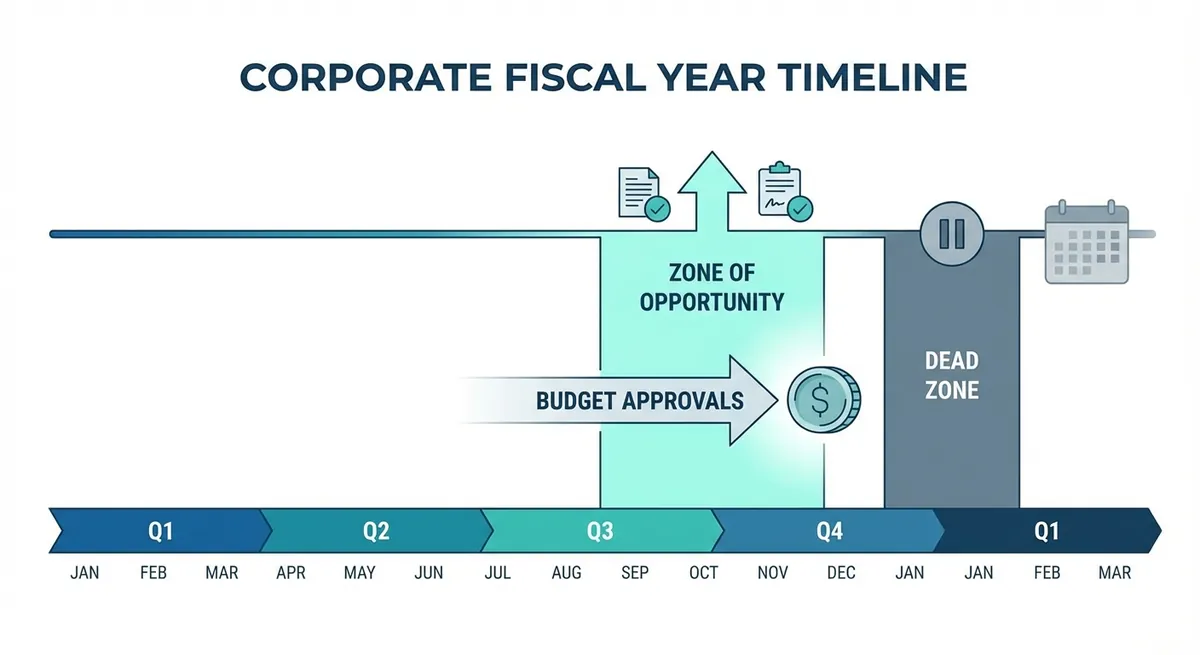
A timeline chart showing a standard corporate fiscal year. It highlights a 'Zone of Opportunity' 3-4 months before annual reviews where budget approvals actually happen, compared to the 'Dead Zone' during the review itself.
How do you figure out your actual market value?
You cannot base your request on what you need to pay your personal bills. You must base it strictly on what your specific skills and experience cost in the open market today.
Dig into the real data
Your feelings don't dictate your paycheck. Market data does. You need to know exactly how to negotiate salary based on facts, not just a gut feeling that you deserve more.
Start by looking at reliable government and industry sources. You can check the U.S. Bureau of Labor Statistics: Occupational Outlook Handbook to find baseline compensation ranges and growth trajectories for your specific industry.
Then get highly specific. Talk to peers in similar roles at different companies. See what external recruiters are currently offering on job boards for your exact job title in your specific city. Geography matters immensely. A marketing manager in New York commands a vastly different rate than one in Ohio.
Build your brag sheet
Before you ask for a raise, you need cold hard facts about your own performance.
The exact same logic applies to raises at your current gig.
Did you save the company 12 hours a week? Did your latest project generate $45,000 in new revenue? Write it down. Put a number on it. If you need help structuring these metrics, our Resume Builder is a fantastic tool for organizing your recent career wins into powerful, quantifiable bullet points.
| Weak Justification | Strong Justification | Why It Works Better |
|---|---|---|
| I have been here a whole year. | I exceeded my annual sales quota by 18%. | Focuses on actual business impact and revenue. |
| My rent went up again. | The median market rate for my role is $75k. | Relies entirely on objective market data. |
| I work really hard every day. | I automated a daily task saving 10 hours weekly. | Quantifies specific, measurable value delivered. |
What exactly should you say during the meeting?
Keep the conversation positive, objective, and completely focused on the mutual value you bring to the business. Leave your personal financial stress out of the room entirely.
The opening pitch
Keep it professional and direct. Never apologize for bringing it up. You earned this meeting.
You might say something like, "I would love to discuss my compensation based on my recent expansion of duties and the results I delivered on the Miller account."
Then, pause. Let them process it.
The experts over at the Harvard Business Review: How to Ask for a Raise suggest framing the request around your future potential with the company, not just past deeds. Show them you are invested in the long game. Talk about the upcoming projects you are excited to tackle.
Handling pushback
Your boss might push back. It happens all the time. They might cite budget constraints or say you need a bit more time in the role.
Do not get defensive. Ask open-ended questions instead. "What specific metrics would you need to see from me over the next six months to make this increase possible?"
Get that plan in writing. Send a polite follow-up email summarizing the milestones you both agreed upon. Now you have a clear roadmap.
What if the answer is a hard no?
Hearing no is rarely the end of the road. It simply shifts the conversation from demanding immediate pay to building a concrete timeline for future growth.
Look beyond the base salary
If the company genuinely cannot bump your base pay right now, pivot. Negotiate other perks. Ask for an extra week of paid time off. Request a flexible work-from-home schedule. Ask them to cover the cost of a professional certification or a massive industry conference.
Compensation is not always just cash. Quality of life has a massive dollar value.
Know when to walk away
And if they completely refuse to give you a path forward? If they brush you off entirely? It might be time to test the waters elsewhere.
You cannot force a company to value you. But you can easily find one that does. Spend a weekend using our LinkedIn Optimizer to polish up your public profile. Start attracting recruiters who will happily pay you exactly what you are worth. Sometimes the biggest raise you will ever get comes from switching companies entirely.
Key Takeaways
- Time your request 3 to 4 months before annual budget reviews.
- Research your true market value using real, location-specific industry data.
- Build a concrete list of specific, quantified achievements.
- Keep the meeting focused purely on business value, not your personal expenses.
- Ask for clear, written milestones if the initial answer is no.
Asking for a raise is always going to feel a bit nerve-wracking. But it is entirely normal. Your employer expects you to advocate for yourself. Remember your actual value, stick to the hard facts, and keep your head held high. And if things don't pan out the way you want, OneTwo Resume is always here to help you build the perfect application materials to go out and land that higher-paying job.