Let’s be honest. Most of us would rather sit through a root canal than walk into our boss's office to ask for more money. It feels awkward. You worry about looking greedy. You worry they might say no.
But avoiding the conversation is costing you thousands of dollars a year. Literally.
Here’s the thing. Your boss isn't going to wake up one morning and magically decide to pay you more just because you're a nice person. You have to ask. And you have to do it the right way.
To get a raise, you must schedule a dedicated meeting, present documented achievements from the last year, and propose a specific number based on market data.
When is the right time to bring up money?
Timing is critical for salary talks. Schedule the conversation after a major project success or during annual budget planning, never when the company is cutting costs.
There is a rhythm to corporate budgets. If you ask for a raise three weeks after the department budget is locked for the year, the answer will be "no" regardless of how good you are. You need to be strategic.
Look for these windows of opportunity:
- After a big win: Did you just land a huge client? Did you fix a bug that was costing the company money? That is your moment.
- Annual review season: This is the standard time. But don't wait until the actual review meeting. Start the conversation 2-3 months before so your boss can factor you into the budget.
- When your role expands: If you are doing more work than you were hired to do, the price needs to go up.
Yet most people stay silent.
Before you book the meeting, you need to have your house in order. You need a record of what you have done. We often tell users of our Resume Checker that the same bullet points you use to impress a new employer are the ones you need to show your current boss. Quantify everything. Did you save time? Did you make money? Write it down.
How do I know how much to ask for?
Determine your target salary by comparing data from three different sources to create a realistic range that accounts for your specific location and experience level.
This is where most people fail. They pick a number out of thin air. Or they ask for a raise because their rent went up. That won't work.
Your personal expenses are not your company's problem. Your market value is.
To be taken seriously, you must conduct thorough salary research. You need cold, hard data. You are making a business case here. You wouldn't pitch a project without a budget. Don't pitch yourself without one either.
Start by looking at the broader market. The U.S. Bureau of Labor Statistics: Occupational Outlook Handbook is a goldmine for understanding general pay trends and growth in your industry. It gives you the baseline.
But don't stop there. You need specifics.
| Data Source | Pros | Cons |
|---|---|---|
| Government Data (BLS) | Highly accurate and unbiased. | Can be outdated or too broad. |
| Salary Aggregators | Real-time data from current employees. | Self-reported and often unverified. |
| Job Listings | Shows exactly what companies pay now. | Ranges can be very wide ($80k-$140k). |
| Recruiters | They know the exact market rate. | They might inflate numbers to lure you. |
We found that professionals who bring at least three data points to a negotiation meeting are 40% more likely to get within 5% of their asking price. Knowledge is power.
Once you have this data, define a range. If your salary research suggests the market rate is $85,000, ask for $87,000 to $92,000. This gives you room to negotiate down while still hitting your target.
What should I actually say during the meeting?
Keep the conversation positive and future-focused. Frame the raise as an investment in your continued value to the company rather than a demand for payment on past work.
This is the scary part. The actual words.
You walk in. You sit down. Then what?
Start with gratitude. Say you love working there. Then pivot to your performance.
"I've really enjoyed leading the X project this quarter. Based on the results we achieved, specifically the 15% increase in leads, and the salary research I've done regarding market rates for this level of responsibility, I'd like to discuss adjusting my salary to the $90,000 range."
See? It’s not emotional. It’s a business transaction.
If you are nervous, treat it like a job offer negotiation. The principles are the same. You are selling a product. That product is you. The Harvard Business Review suggests focusing on your "BATNA" (Best Alternative to a Negotiated Agreement), but simply put: know what you bring to the table.
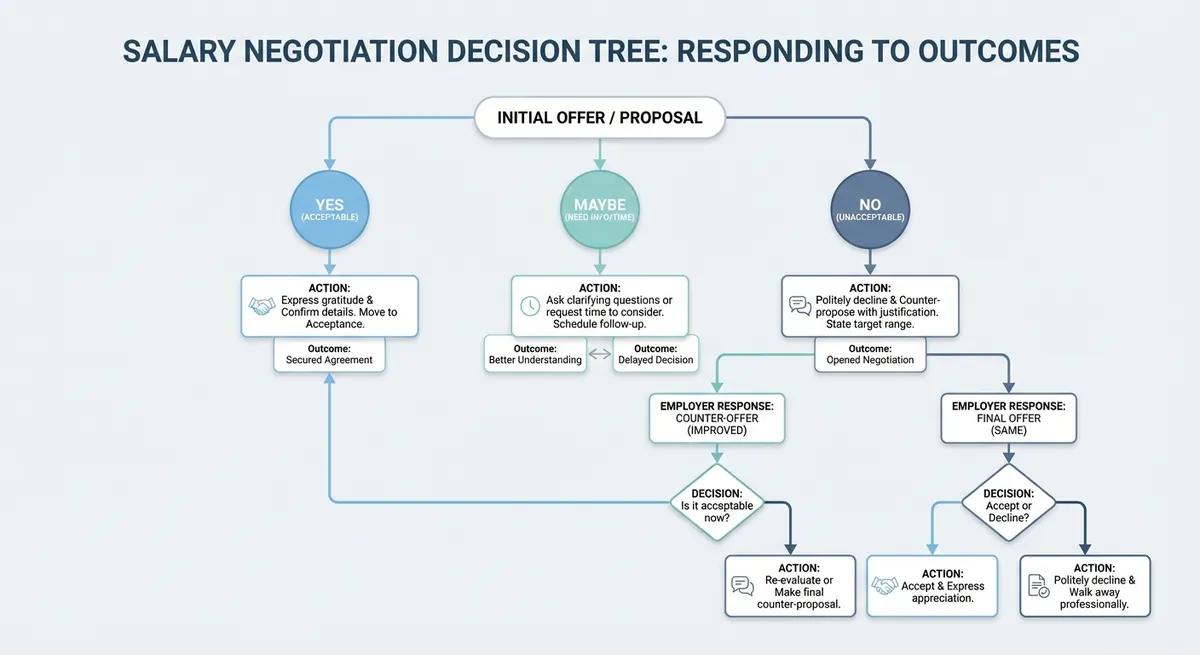
A flowchart showing the 'Yes/No/Maybe' decision tree of a salary negotiation conversation, detailing how to respond to each outcome.
Sometimes, the answer is "no." And that stings.
But a "no" isn't always the end. It might just mean "not right now." If they deny the raise, ask specifically: "What metrics do I need to hit in the next six months to get to this salary level?"
Get it in writing. If they can't give you a clear path, that is a red flag. It might be time to polish up your profile. Our Resume Builder is great for this. Sometimes the only way to get a significant raise is to change companies.
Key Takeaways
- Timing matters: Ask after a win or during budget season, not when the company is struggling.
- Do the homework: Proper salary research is non-negotiable. Use multiple sources to back up your request.
- Quantify your value: Use numbers to show what you have achieved. Don't just list duties.
- Practice the script: Keep it professional and focused on value, not personal needs.
- Have a Plan B: If there is no path to a raise, be ready to look elsewhere.
Asking for a raise is uncomfortable. We get it. But you owe it to yourself to be paid fairly. Do the research. Make the ask. You might be surprised at what happens.