In 2025, an ATS is primarily a digital filing cabinet that parses your text to rank relevance based on specific hard skills found in the job description.
You hit "Apply." Then you wait. And wait. It feels like throwing a paper airplane into a black hole. We have all been there. It is the most frustrating part of the modern job hunt.
Most people blame the robots. They think a malicious AI is scanning their life's work and laughing at it. But the reality is much more boring. And honestly? It’s much easier to fix once you know the rules.
Here is the thing. The Applicant Tracking System (ATS) isn't your enemy. It is just an overworked librarian.
Recruiters are drowning in applications, and they cannot read every one closely. So they use software to organize, filter and rank the pile: in Harvard Business School and Accenture's 2021 Hidden Workers survey, more than 90% of employers said they use their recruiting system to initially filter or rank candidates. (The familiar "250 resumes per opening" and "75% rejected by the ATS" figures have no primary source — we traced them in our ATS statistics source check.) If you want to get seen, you need to understand how the machine thinks.
Do robots actually read my resume?
The ATS does not read your resume like a human does; it converts your document into a plain-text digital profile and searches for matching data points.
People think the ATS is analyzing their career trajectory. It isn't. It is parsing text.
The parsing process
When you upload your file, the system strips away your pretty fonts. It ignores your nice colors. It tries to pull raw text and categorize it. It looks for a heading that says "Experience" and dumps everything under it into the "Work History" box in its database.
If you use a fancy two-column layout or unique icons, the parser gets confused. It might mash your job title together with your date of employment. Suddenly, the system thinks your job title is "Project Manager 2020." That is not a real job.
To beat the ATS, you have to hand it the data on a silver platter. Keep the structure simple. Standard headings help the system know exactly where to look.
The keyword matching game
This is where resume keywords come into play. The recruiter types specific terms into a search bar. Usually, these are hard skills like "Python," "Project Management," or "GAAP Accounting."
If you have those exact words in your profile, you show up in the search results. If you don't? You are invisible. It works just like Google.
For example, writing "Client Relations" when the job asked for "Customer Success."
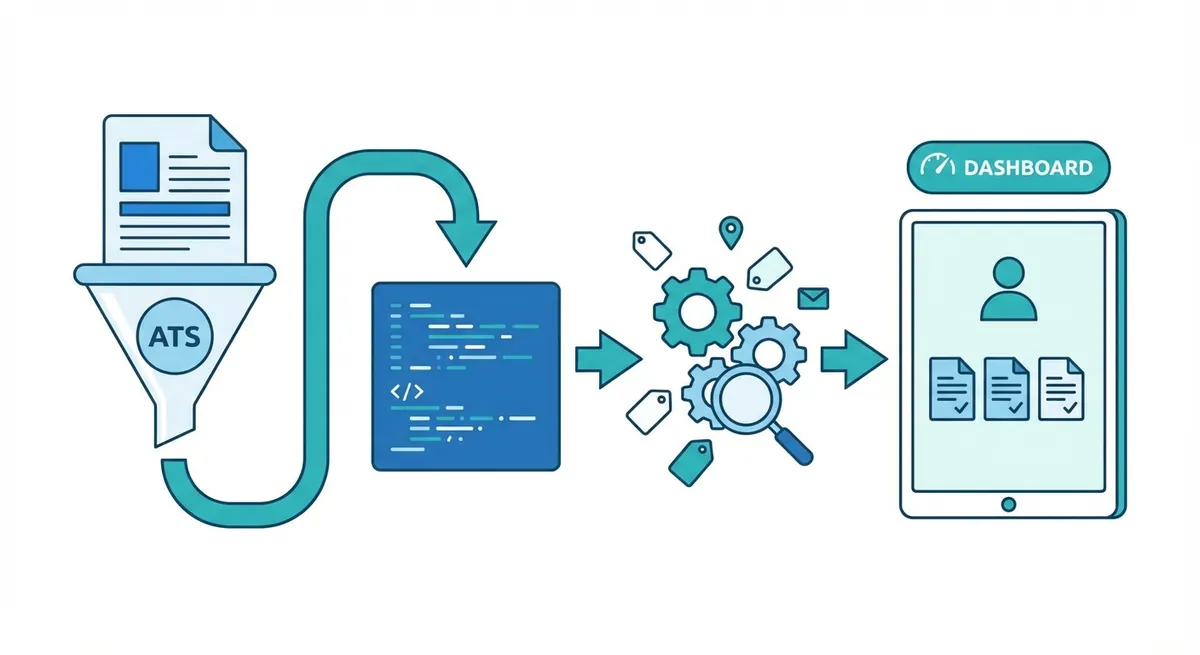
Visual flow chart showing a resume entering an ATS, being stripped to raw text, filtered by keywords, and finally appearing on a recruiter's dashboard
Why are qualified candidates getting rejected instantly?
Instant rejections usually happen because of knockout questions or formatting errors that make your resume appear blank to the system.
It stings. You get a rejection email three minutes after applying. Did a human see it? No. Definitely not.
Knockout questions
These are the bouncers at the door. When you fill out the application, you answer questions like "Are you authorized to work in the US?" or "Do you have 5 years of experience?"
If you answer incorrectly based on their requirements, the software automatically moves you to the "Rejected" pile. No human eyes ever touch your resume. It’s brutal. But it saves recruiters time on candidates they literally cannot hire.
The invisible resume
Sometimes, you are the problem. Well, your file is. If you upload a complex graphic resume or an image-based PDF, the ATS might scan it and see nothing. Zero text. Just a blank page.
If the system sees a blank page, it assumes you have zero skills. That is the fastest way to get rejected.
This contributes to what researchers call the "hidden worker" problem. According to a study on Hidden Workers: Untapped Talent, millions of people are shut out of the workforce simply because automated systems are too rigid. Don't let your formatting be the reason you stay hidden.
How do you optimize for 2025 systems?
Optimization requires using a standard, single-column layout with standard fonts and mirroring the exact language used in the job description.
You might be tempted to get creative. Don't. Save your creativity for your portfolio or the interview. For the resume, you need to be boringly efficient.
Format for the machine first
There is a lot of bad advice out there. Influencers will tell you to put your photo on your resume. Or use a skill bar graph. These are terrible ideas for an ATS friendly resume.
Here is a breakdown of what actually works versus what breaks the system:
| Element | ATS Friendly (Do This) | ATS Confusing (Avoid This) |
|---|---|---|
| File Type | .docx or text-based .pdf | Images, .png, or Photoshop files |
| Layout | Single column, left-aligned | Multiple columns, floating text boxes |
| Headings | "Experience", "Education", "Skills" | "My Journey", "What I've Done", "Know-How" |
| Fonts | Arial, Calibri, Roboto, Helvetica | Custom script fonts, heavy italics |
| Graphics | None. Text only. | Logos, charts, skill bars (e.g., 80% Java) |
If you aren't sure if your current formatting is holding you back, you can run it through our Resume Checker. It simulates an ATS scan and tells you exactly what the robot sees.
Context is king in 2025
Older systems just counted keywords. If you wrote "SEO" 50 times in white text, you could cheat the system. That doesn't work anymore. In fact, it will get you blacklisted.
Modern systems use semantic search. They understand context. They know that "managed a budget" is similar to "financial oversight."
However, you shouldn't rely on the AI being smart. It is safer to mirror the language in the job post. If they ask for "B2B Sales," don't just write "Business Sales." Use their exact words. This is the single most effective way to beat the ATS.
For a deeper dive into the technical side, this guide on What Is an Applicant Tracking System? breaks down the vendor landscape well.
Customize every single time
I know. It is annoying. But sending the same generic resume to 50 jobs is a waste of time. You are better off applying to 5 jobs with 5 highly tailored resumes.
Truth is, you need to swap out your resume keywords for every application. If you need help speeding this up, our Resume Builder allows you to duplicate and tweak resumes in seconds so you aren't starting from scratch every time.
Key Takeaways
- Keep it simple. Use standard headers and avoid graphics, columns, or tables that confuse the parser.
- Match the vocabulary. Read the job description and use the exact same hard skills in your resume profile.
- Don't try to trick it. Keyword stuffing or using white text is a dated tactic that will get your application flagged.
- Focus on knockout questions. Ensure you meet the core requirements before spending an hour applying.
- Test your file. If you can't highlight the text on your PDF, the robot can't read it either.
Trying to beat the ATS isn't about hacking a mainframe. It is about communication. You are translating your human experience into data the system can understand. Once you speak the language, getting to the interview becomes a whole lot easier.
Ready to get past the bots? OneTwo Resume helps you build, scan, and optimize your application in minutes.