Look. You've hit submit on your job application and now you wait. And wait. You start wondering if your carefully crafted PDF just vanished into a black hole. Truth is, it probably went straight into an applicant tracking system. People constantly tell you to cram your resume with exact keywords to survive this digital gauntlet. But is that actually how it works anymore?
Modern ATS platforms use AI to understand the actual context of your skills rather than just hunting for exact keyword matches.
Let's talk about the reality of modern hiring software. Job seekers are incredibly tired of getting ghosted. You want to beat the ATS. To do that, you need to understand the massive shift happening behind the scenes. Understanding modern resume parsing is your best defense. The rules of the game have changed, and relying on outdated advice is a great way to stay unemployed.
How do exact match keywords work in legacy systems?
Older screening tools act like simple search engines. They only recognize exact word matches and completely ignore related skill variations.
The old-school CTRL+F method
Think about the early days of resume screening. Systems were basic. They scanned your document using simple text matching. If the job description asked for "Search Engine Optimization" and you wrote "SEO" on your resume, you were basically screwed. The computer was simply too literal to connect the dots. It was incredibly frustrating. You had to mirror the job description word for word just to get a human to look at your application.
Why exact matching causes problems
This literal approach created a massive headache for everyone involved. Good candidates got automatically rejected over minor phrasing differences. Meanwhile, bad candidates slipped right through just by copying and pasting the job description in invisible white text. It was a complete mess.
Even today, some companies stubbornly use these outdated systems. And it drastically hurts their hiring pipelines. Research from Harvard Business Review: Are Automated Hiring Systems Missing the Mark? highlights how these rigid tools accidentally filter out millions of highly qualified workers. They hide top talent behind arbitrary technical barriers.
What are conceptual keywords and how does AI read them?
Smart systems understand relationships between words. They know that managing client relations and customer service often require identical underlying skills.
The rise of smart resume parsing
Here's the good news. Technology evolved. Today we have intelligent resume parsing technology. Modern software doesn't just read words anymore. It actually reads meaning.
When you upload your document, the system extracts your data. Intelligent resume parsing categorizes your experience into structured profiles using natural language processing. It grasps the total picture. If a posting asks for "data analysis" and you wrote "analyzed large datasets using Python to find trends", the system gives you full credit. It knows those concepts belong together.
Context matters more than frequency
Stop repeating the same buzzword five times. It looks weird to human readers. It also doesn't help you with a modern applicant tracking system.
These modern systems weigh the context surrounding a keyword. They desperately want to see how you used a skill in the real world. Did you just lazily list "Project Management" at the bottom of the page? Or did you write "Managed a $500k project budget and led a cross-functional team of ten"? The second option carries way more weight. If you need help finding standard job terms to build this context, O*NET OnLine (U.S. Department of Labor Occupational Database) is a fantastic free resource to see how skills group logically.
The end of keyword stuffing
Keyword stuffing is dead. Trying to cheat the system usually backfires now.
The software is simply too smart for old tricks.
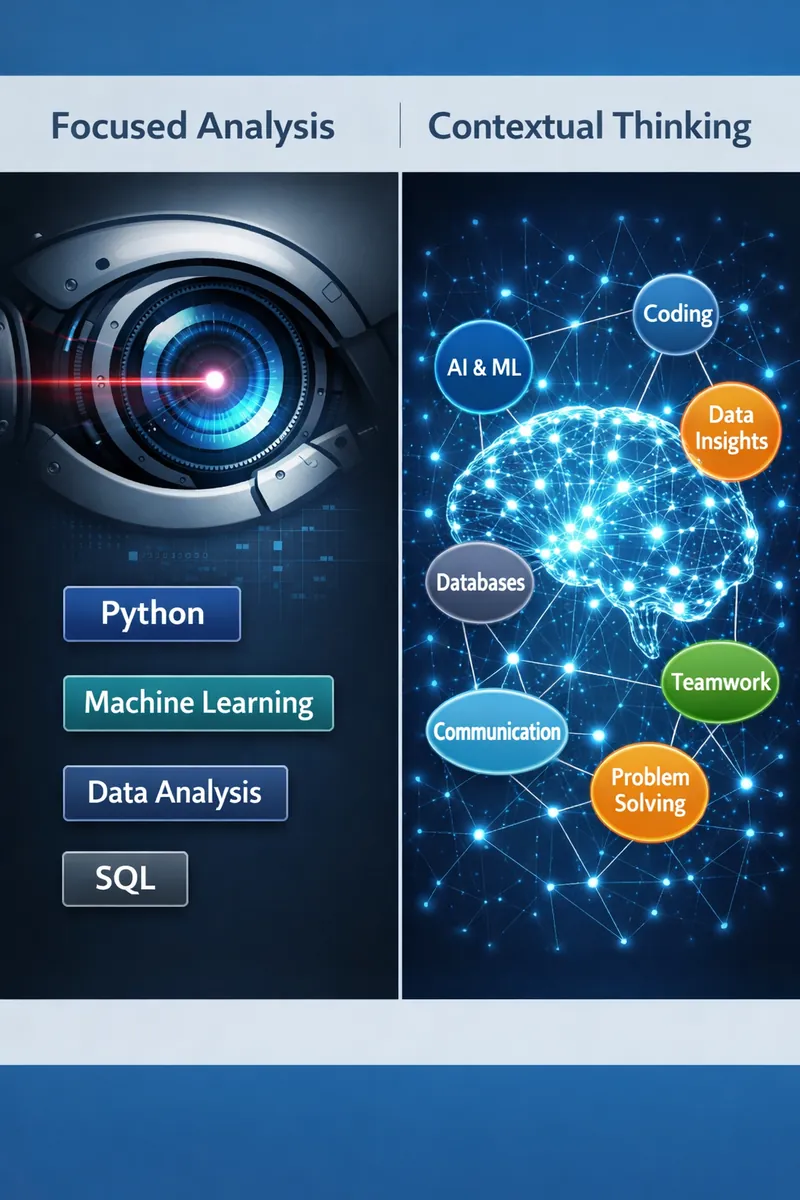
A side-by-side visual showing a robotic eye scanning exact isolated words on the left, versus an AI brain connecting related skill nodes in a glowing web of context on the right.
How can you optimize your resume for both systems?
The best approach requires a hybrid strategy. You must use standard industry terms while providing enough rich context to prove your actual competence.
Balance exact terms with context
You don't always know which system a company uses. They might have a state-of-the-art AI platform. They might have a ten-year-old legacy tool. You have to prepare for both.
Use the exact term from the job description once or twice. Then expand on it with conceptual variations. This easily covers your bases. If you want to see how your current document stacks up against these algorithms, run it through a reliable Resume Checker to spot missing contextual links before you hit submit.
Focus on the core skills
Don't try to match every single minor requirement listed. Focus heavily on the hard skills that actually matter for the role.
They want proof. Build your bullet points around action and real results. A good Resume Builder will prompt you to include these measurable metrics naturally without sounding like a robot.
Let's look at a quick comparison to make this super clear.
| Feature | Exact Match System | Conceptual AI System |
| --------- | -------------------- | ---------------------- |
|---|---|---|
| Matching Style | Literal word-for-word | Contextual and related meaning |
| "SEO" vs "Search Engine Optimization" | Seen as two completely different things | Recognized as the exact same skill |
| Best Strategy | Mirroring the job description precisely | Showing how skills were practically applied |
| Keyword Frequency | Higher repetition sometimes helped | Repeated words offer diminishing returns |
Key Takeaways
- Stop worrying about matching the exact phrasing of every single bullet point in a job description.
- Modern resume parsing relies on context and natural language processing to evaluate your actual competence.
- Focus on telling a clear story about your achievements instead of cramming buzzwords into a dense skills section.
- Write for human hiring managers first. Smart algorithms are designed to read exactly like humans do.
The job search is hard enough without constantly guessing how a computer reads your file. Stop playing the keyword guessing game. Focus on clear language and measurable results. If you're ready to create a document that appeals to both smart algorithms and real human beings, try OneTwo Resume today to build your next standout application.