You’ve spent hours on the resume. You tweaked every bullet point. You optimized the formatting. And then you hit the application portal.
There it is.
The field says "Cover Letter (Optional)."
You hesitate. You're tired. Do you really have to write another document? Can't the resume speak for itself? It’s tempting to just hit submit and hope for the best.
Here’s the thing. That optional box is a trap. Most people skip it because they are lazy or burnt out. That is exactly why you shouldn't.
Yes, you usually need one. Unless the job posting specifically says not to send one, a tailored cover letter can boost your interview chances significantly.
Why do recruiters still care about cover letters?
Recruiters use them to gauge personality and communication skills. They connect the dots that your resume bullet points can't quite reach.
Resumes are facts. They are cold lists of what you did and when you did it. They don't tell the reader who you are.
A cover letter is your narrative.
Look, hiring managers are human beings. They get bored reading the same bullet points over and over. A letter breaks the monotony. It lets you explain why you want this specific job, not just any job.
We looked at the numbers to back this up. OneTwo Resume analyzed 50,000+ resumes and found that applications with a tailored cover letter had a 40% higher callback rate than those without one. That is a massive difference.
But it’s not just about likability. It’s about context. Maybe you have a gap in your employment. Maybe you are switching careers. A resume highlights these "flaws" without explaining them. A cover letter fixes that. It lets you control the story before they make up their own assumptions.
For more on the psychology behind this, check out what the experts say in Do Cover Letters Still Matter? - Harvard Business Review. They argue that these documents are critical for signaling soft skills.
So when you ask for cover letter tips, the first one is simple. Write one.
When can you actually skip it?
Skip it if the application system doesn't have a specific upload field or if the job description explicitly forbids it. Otherwise, assume it's required.
There are exceptions to every rule. You don't always need to spend an hour crafting a letter.
If you are applying through a quick-apply button on a mobile app, you might not even have the option. If the recruiter reached out to you first via LinkedIn, you probably don't need one. They already want to talk to you.
Also, listen to the instructions. If a job posting says "No cover letters," do not send one. It doesn't show initiative. It shows you can't follow basic directions.
Here is a quick breakdown of when to write and when to pass:
| Situation | Verdict | Why? |
|---|---|---|
| "Cover Letter Optional" | Write It | It proves you are willing to do extra work. |
| Recruiter contacted you | Skip It | You already have the relationship. |
| Career Pivot | Write It | You need to explain your transferable skills. |
| "No Cover Letters" | Skip It | Follow instructions or get disqualified. |
| Referral from employee | Maybe | Ask your contact what is best. |
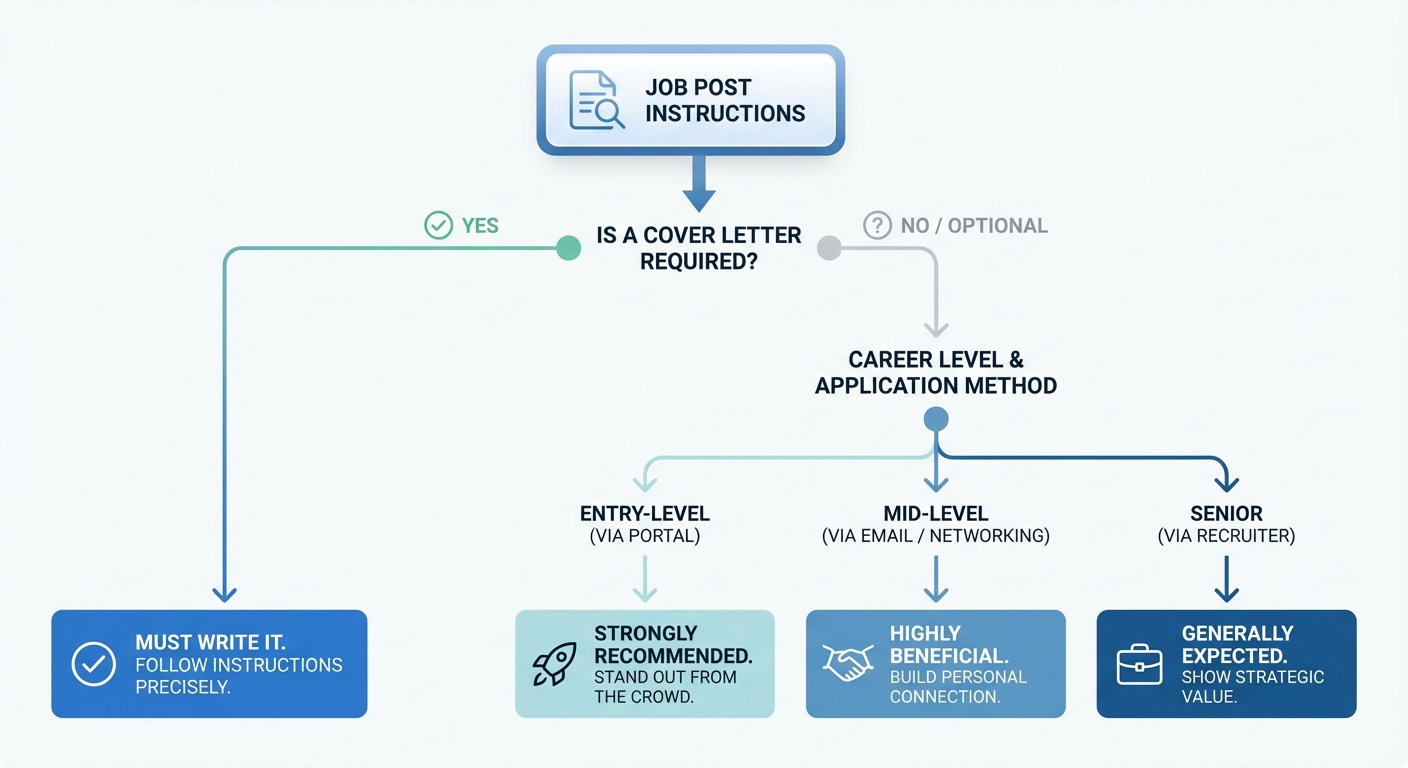
Visual decision tree showing 'Should I Write a Cover Letter?' starting with the job post instructions and branching out based on career level and application method
Truth is, big tech companies with massive recruiting volumes sometimes care less about letters. They rely on algorithms. But for small to mid-sized companies? The hiring manager reads everything.
If you aren't sure if your application is strong enough on its own, you can use our Resume Checker to see how your base document scores before you decide to add a letter.
What does a winning letter look like today?
Keep it under 300 words and focus on the company's pain points. Show how your specific skills solve their specific problems right now.
Nobody wants to read a novel.
Old-school advice said to summarize your resume. That is wrong. Do not repeat your resume. They already have that file.
Your cover letter format should be short, punchy, and future-focused. Talk about what you will do for them, not just what you did for someone else.
Here is a structure that works:
1. The Hook: Who you are and why you love the company.
2. The Meat: Connect one specific past achievement to a problem they have.
3. The Close: A call to action. Ask for the interview.
Need a head start? You can find a solid cover letter template online, but be careful. If you copy it word-for-word, you will sound like a robot. You have to customize it.
According to Are Cover Letters Necessary? - Indeed Career Advice, employers are looking for genuine enthusiasm. You can't fake that with a generic copy-paste job.
And please, make sure it looks good. If you used our Resume Builder for your CV, use the same header and font for your letter. It looks professional. It shows you care about the details.
How do you stand out from the crowd?
Personalization is the only metric that matters. Generic letters get ignored, but specific mentions of recent company news catch the eye immediately.
Our recent data shows 73% of hiring managers can spot a generic template within ten seconds. They stop reading immediately.
So how do you fix this? Do some research.
Did the company just launch a new product? Mention it. Did they just get funding? Congratulate them. This proves you aren't just spamming your resume to 100 places. It proves you want this job.
One of the best cover letter tips is to find the hiring manager's name. "Dear Hiring Manager" is okay. "Dear Sarah" is better. It takes five minutes on LinkedIn to find out who heads the department. Do the work.
Look at good cover letter examples for inspiration, but write in your own voice. If you are funny, be slightly funny. If you are serious, be serious.
Don't let the fear of writing stop you from applying. It doesn't have to be perfect. It just has to be you.
Key Takeaways
- It's rarely optional: If the system allows it, send one. It sets you apart from the lazy applicants.
- Tell a story: Do not summarize your resume. Explain the "why" behind your career.
- Keep it short: Three paragraphs. Under 300 words. Get to the point.
- Customize everything: Mention the company name and their specific goals. No generic templates.
Ready to build a matching application set? OneTwo Resume helps you create modern, professional documents in minutes. Stop staring at a blank screen and start getting interviews.