Let's be honest for a second. Writing a cover letter is painful.
It feels like shouting into the void. You spend an hour crafting the perfect opening line. You obsess over the tone. You adhere to every formatting rule. Then you hit send and wonder if a human will ever actually see it.
It is tempting to skip it. Especially when the application form says "optional" next to the upload button. But should you? Is this document a relic of the past or your secret weapon?
While 47% of recruiters might skip them initially, a well-written cover letter is often the deciding factor between two equally qualified candidates in the final rounds.
When is a cover letter actually mandatory?
You must submit one if the application explicitly asks for it, if you are referred by a contact, or if the role requires strong writing skills.
Here is the thing. Most people treat the word "optional" as permission to do less work. That is a mistake.
Think of the hiring process like a tie-game. You and another candidate have similar experience. You both went to decent schools. You both used our Resume Builder to create crisp, professional documents. Who gets the interview?
The person who took the extra twenty minutes to explain why they want the job. Not just that they want it.
That is not a small margin. It is a quarter of a chance you are throwing away by being lazy.
However, there are exceptions. You can probably skip it if:
- Recruiters reach out to you first via LinkedIn.
- The application form has no place to upload it.
- You are applying for a high-volume trade job where speed is the only factor.
But for everyone else? It matters. For more perspective on this, the Indeed Career Guide breaks down exactly how different industries weigh these documents differently.
What makes a modern cover letter work?
Stop summarizing your resume. Instead, tell a specific story that connects your past wins to the company's future goals and culture.
The biggest error candidates make is regurgitation. They take their bullet points and turn them into sentences. This is boring. Hiring managers hate boring.
A great cover letter does what a resume cannot. It shows personality. It explains gaps. It connects the dots between a career change and the new role.
Look at the difference in approach:
| Feature | Old School Style | Modern Strategy |
|---|---|---|
| Opening | "I am writing to apply for..." | "Your recent launch caught my eye because..." |
| Focus | Past duties and responsibilities | Future value and problem solving |
| Tone | Overly formal and stiff | Professional but conversational |
| Length | Full page (400+ words) | Tight and punchy (200-300 words) |
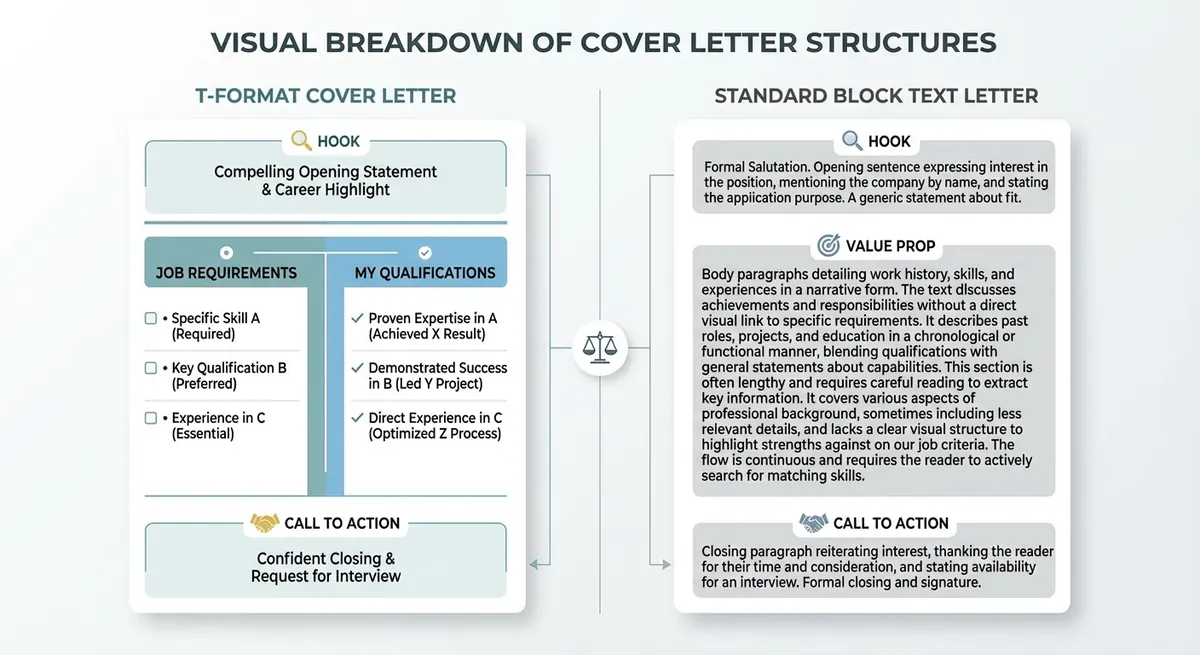
A visual breakdown of the 'T-Format' cover letter structure vs. a standard block text letter, highlighting where to place the 'hook', the 'value prop', and the 'call to action'.
Even Harvard Business Review notes that while the medium changes, the need to convey your narrative remains critical. You need to show you have done your homework.
How can you write one quickly without losing quality?
Use a flexible framework rather than writing from scratch every time. Focus on a strong opening hook and a specific value proposition.
Nobody has time to write unique novels for fifty different job applications. That is a recipe for burnout.
The solution is a hybrid approach. You need a solid cover letter template that handles the formatting and structure for you. But you cannot copy-paste the body text.
They can smell a form letter a mile away. It tells them you do not care about their specific company. You just want a job. Any job.
Here are three rapid-fire cover letter tips to speed up your process:
1.The Hook: Spend 5 minutes researching the company news. Mention a recent product launch or award in sentence one.
2.The Bridge: Use the middle paragraph to pick one resume achievement and explain the context behind it. How did you do it?
3.The Close: Keep it simple. Ask for the chat.
If you use a cover letter template, make sure the design matches your resume exactly. Inconsistent fonts or colors make you look disorganized. You can ensure everything looks cohesive by running your documents through our Resume Checker before you hit submit.
Using a cover letter template is smart leverage. Relying on it entirely is a mistake.
Key Takeaways
- Don't skip it: Unless the application blocks you from sending one, write the letter. It increases your odds significantly.
- Don't repeat yourself: Your resume lists history. Your cover letter tells your story. Use the space to explain the "why."
- Customize the start: Generic openings kill your chances. Always tailor the first paragraph to the specific company.
- Keep it short: 250 words is usually plenty. Respect the recruiter's time.
Conclusion
The job market is noisy. A cover letter is your chance to grab the microphone for thirty seconds. Don't waste it. If you need help getting started, OneTwo Resume has the tools to make your application stand out from the pile.