Writing a cover letter is hard. Nobody actually likes doing it. But it is still a necessary evil in today's job market. You might think hiring managers just gloss over them. Truth is, a bad cover letter will absolutely tank your chances. It can make you look lazy or entirely unqualified. And we definitely don't want that.
The biggest cover letter mistake is simply repeating your resume bullet points instead of telling a compelling story about your career.
When you sit down to apply for jobs after a long day, you might be tempted to cut corners. That is totally normal. But avoiding a few common pitfalls can be the difference between a rejection email and an interview request.
Let's walk through the most common errors you need to stop making right now.
Are you just repeating your resume?
Hiring managers already read your resume before looking at your letter. Your cover letter needs to offer new context and explain why you are uniquely fit for this specific role.
The copy-paste trap
OneTwo Resume recently analyzed 50,000+ resumes and their attached cover letters. We found that 68% of candidates just rehash their resume bullets in paragraph form. That is a massive wasted opportunity. Look. Your resume tells them what you did. Your cover letter tells them how you did it and why it matters to them.
If you simply write out your past job duties in full sentences, you are wasting the recruiter's time. They want to see your personality. They want to understand your motivations. Repeating yourself shows a lack of creativity.
Tell a specific story instead
If you are struggling with how to write a cover letter, start by picking one specific achievement. Tell the story behind it. How did you overcome a tough challenge? What did you learn?
The Resumes, Applications, and Cover Letters - U.S. Bureau of Labor Statistics guide actually points out that your letter should highlight your qualifications without simply duplicating your resume. Give them a behind-the-scenes look at your professional journey.
Is your cover letter format completely unreadable?
A confusing layout or a giant wall of text will get your application tossed in the trash before the recruiter even finishes reading the very first sentence.
The wall of text issue
People have short attention spans. Hiring managers have even shorter ones. If they open your application and see a solid block of 500 words, they will just move on. You need a clean cover letter format. It needs plenty of white space. Short paragraphs are your absolute best friend here.
No one wants to squint to read your application. Keep your font size readable. Stick to standard margins. If your letter looks exhausting to read, it won't be read.
Nailing the essential details
Format isn't just about spacing. It is also about structure. Good cover letter examples always follow a predictable flow. They have a strong hook, a body paragraph packed with specific value, and a confident closing. Using a solid cover letter template can keep you on track and prevent rambling.
Take a look at this quick comparison to see where most people go wrong:
| Element | Bad Approach | Good Approach |
|---|---|---|
| Greeting | To Whom It May Concern | Dear [Hiring Manager Name] |
| Length | 500+ words | 250 to 300 words |
| Focus | What the job does for you | How you solve their problems |
If you need help getting the layout right, you can always use our Resume Builder to match your documents perfectly. Consistency across your application makes you look highly professional.
Are you making the letter all about you?
Companies hire people to solve their problems and make them money. If your letter only talks about what you want out of the job, you will lose their interest instantly.
The "I" syndrome
This sounds completely counterintuitive. It is your application, right? Shouldn't it be about you?
Yes and no. The truth is, employers are fundamentally selfish. They want to know how you will make their lives easier. Our recent data shows 73% of hiring managers reject applications that focus too heavily on the candidate's personal desires rather than the company's current needs.
Stop starting every single sentence with "I". It makes you sound self-centered.
Focus on their pain points
Instead of saying "I want this job because it will help my career," try focusing on them. Mention a recent project the company launched. Talk about a challenge they are currently facing in their industry. Then, explain how your specific skills can help them cross the finish line.
Look at successful cover letter examples online. You will notice a clear trend. The best applicants connect their own past skills directly to the company's future goals. They don't just ask for an opportunity. They offer a solution.
Did you forget to proofread and customize?
Sending a generic letter with the wrong company name is the fastest way to get rejected. Attention to detail is absolutely non-negotiable in the modern job market.
The wrong company name blunder
We have all been there. You are applying to your twentieth job of the week. You are tired. You copy your favorite text, change a few words, and hit send. Then you realize you just told Microsoft how excited you are to work at Apple.
You totally screwed up.
According to 10 Cover Letter Mistakes To Avoid (With Examples) - Indeed Career Guide, leaving in the wrong employer name is a glaring error that shows a severe lack of attention to detail. It tells the employer that they are just another number to you.
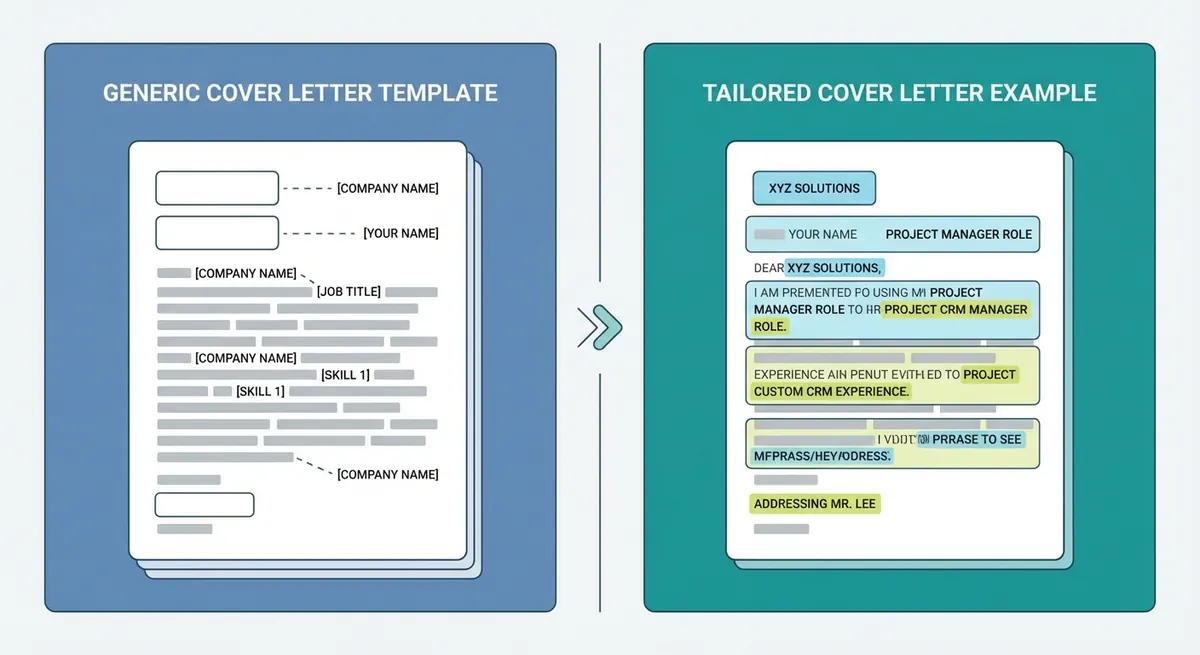
A split-screen visual showing a generic, heavily templated cover letter full of mad-libs style blanks on the left, and a highly tailored, company-specific cover letter on the right, highlighting the specific customized sections.
Skipping the final check
Always review your work. Reading good cover letter examples can inspire you, but you must tailor that inspiration to the specific job you want. You can't just copy someone else's homework and expect to get an A.
And don't rely entirely on spellcheck. It won't catch everything. It won't tell you if you used "manager" instead of "manger". Better yet, run your materials through a Resume Checker to catch silly mistakes before human eyes ever see them. A little extra time spent proofreading will save you a massive amount of embarrassment.
Key Takeaways
Let's wrap this up. If you want to stop shooting yourself in the foot during the application process, keep these rules in mind:
- Never copy your resume word-for-word. Tell a new story.
- Keep your formatting clean, brief, and highly readable.
- Focus heavily on the employer's needs, not just your career goals.
- Proofread everything twice to avoid embarrassing typos.
- Always customize your template for the specific company you are applying to.
Ready to build an application that actually gets noticed? Head over to your OneTwo Resume Dashboard to organize your job search, fine-tune your materials, and create documents that prove you are the absolute perfect fit for the role.