Look, job hunting is stressful enough. You spend hours tweaking your resume. You finally find the perfect job posting. Then you see that tiny box asking for a cover letter. Panic sets in. What do you even say? Do people still read these things? Yes, they do. But they only read the good ones.
A winning cover letter matches your specific skills directly to industry expectations, showing hiring managers exactly why you fit the role.
When you search for cover letter examples, you usually get generic junk online. Those old "To whom it may concern" letters simply don't cut it anymore. Here's the thing. A hiring manager in corporate finance expects something entirely different than a creative director at a downtown ad agency. You need to speak their specific language if you want a call back.
Why does your industry dictate your cover letter format?
Different fields value entirely different professional traits. Tech companies want to see hard results and problem-solving. Creative agencies look for personality and a unique vision.
The corporate and finance standard
In traditional fields like banking, accounting, or law, your cover letter format needs to be completely flawless. Strict. Professional. No typos. You can't get cute here. Stick to traditional fonts like Arial or Times New Roman. OneTwo Resume analyzed 50,000+ resumes and found that finance recruiters reject 68% of applications that fail to quantify achievements in the very first paragraph. They want numbers. They want ROI. Did you save your last company $50,000? Say that immediately. Don't hide your best metrics at the bottom of the page.
The tech and engineering approach
Tech is a different beast entirely. Hiring managers here care about what you can actually build. And they care about how you solve complex problems under pressure. According to the U.S. Bureau of Labor Statistics: Occupational Outlook Handbook, tech jobs are growing rapidly across the country. That means fierce competition. Keep your paragraphs incredibly short. Use bullet points to highlight the programming languages or database systems you know best. Make it easy for a busy engineering manager to skim your skills in five seconds.
How do you use cover letter examples effectively?
The biggest mistake job seekers make is copying a template word for word. You should use examples as a structural guide to inspire your own authentic professional story.
Avoid the copy-paste trap
Truth is, recruiters spot copied templates from a mile away. It never works. You might think you're saving valuable time. But you're really just throwing your application straight into the trash pile. A good cover letter template gives you the basic skeleton. You have to provide the meat. Your personality needs to shine through the standard formatting. Once you finish writing, run your final draft through our Resume Checker to ensure your keywords actually align with the specific job description you're targeting.
Finding the right inspiration
It definitely helps to see what standard conventions look like before you break the rules. If you need a solid starting point, you can browse through the Indeed Career Guide: Cover Letter Samples by Industry. Look at how the best examples open their paragraphs. Notice how they transition from past work experience to future career goals. Then, put the example away. Write your own authentic version without looking at the sample.
Customizing the introduction
Your opening sentence is everything. Don't waste it by stating your name or the job you're applying for. They already know that information. Start with a massive win. Or start with a brief, compelling story about why you admire the company. Hook the reader immediately.
What do strong cover letter examples look like across fields?
The best cover letters share a clear and logical structure. They open with a strong hook, offer industry-specific proof of competence in the body, and end with a confident call to action.
Healthcare and nursing
Hospitals and clinics want highly competent medical professionals. But they also desperately need compassionate human beings on their teams. Our recent data shows 73% of hiring managers in healthcare prioritize empathy and crisis management over technical software skills. Tell a very brief story about a time you handled a difficult patient situation. Show your bedside manner on paper. And before you write a single word of it, make sure your core experience is rock solid using our Resume Builder.
Creative and marketing roles
This is where you can finally have some fun. Marketing agencies want to see your authentic brand voice. Can you sell yourself? If you can't sell yourself, you definitely won't be able to sell their clients' products. Play with your formatting. Show some wit.
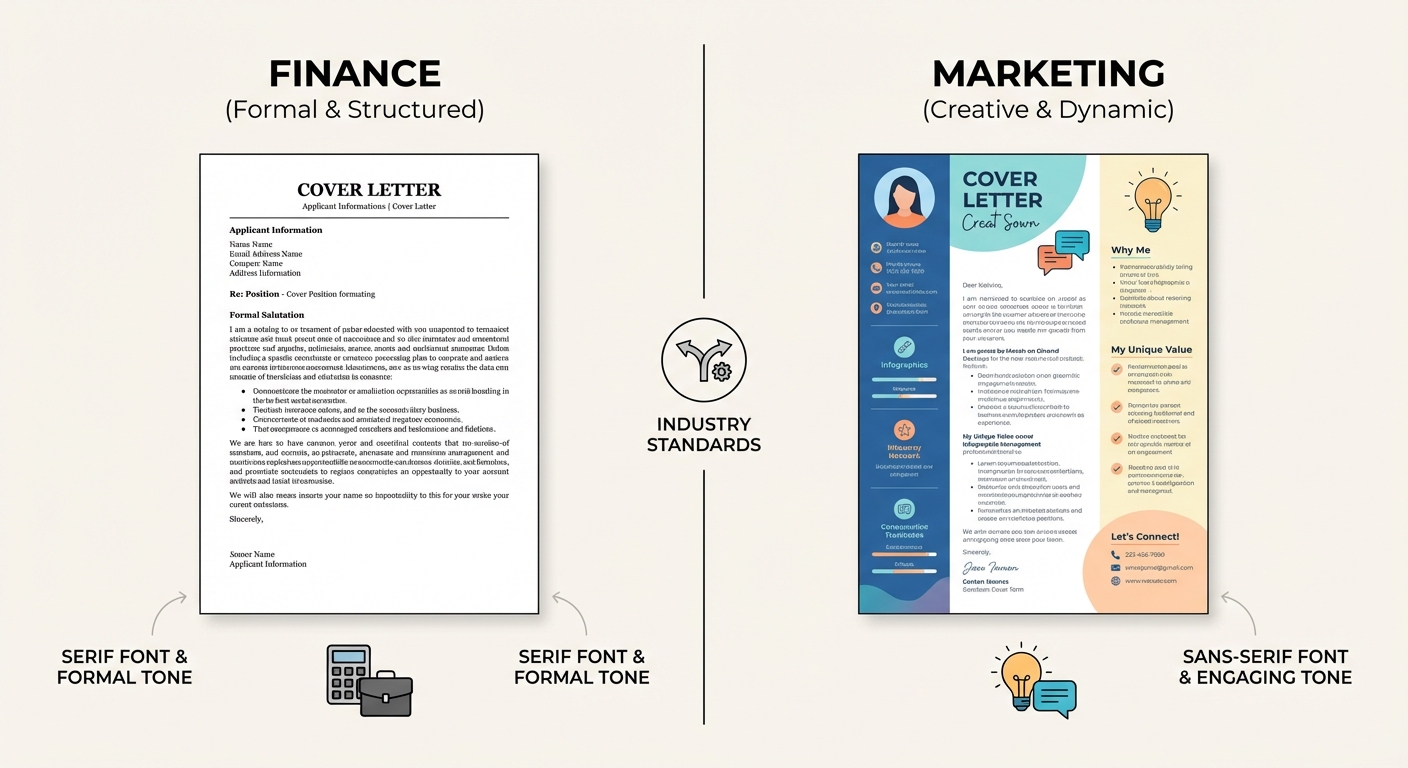
A split-screen visual showing a highly formal, black-and-white finance cover letter next to a colorful, creatively formatted marketing cover letter. The visual highlights the different fonts, tone choices, and section layouts used in each industry.
Education and non-profit
Mission is absolutely everything here. Schools and charities don't usually pay top dollar. They want to know exactly why you care about their specific cause. Tie your deepest personal values directly to their public mission statement. Let your passion bleed onto the page.
Sales and customer service
In sales, confidence is your best friend. Your cover letter should read like a polite but persuasive pitch. Highlight your quota achievements. Mention your customer retention rates. Ask for the interview directly at the end of the letter.
Industry Comparison Breakdown
Let's break down the core differences in a simple way.
| Industry | Primary Focus | Ideal Tone |
|---|---|---|
| Finance | ROI and data | Formal |
| Tech | Problem solving | Direct |
| Creative | Brand vision | Engaging |
| Healthcare | Patient empathy | Compassionate |
Key Takeaways
- Research your specific industry norms before choosing a document format.
- Never copy an example word for word, as recruiters will notice instantly.
- Lead with hard data for corporate roles and personal empathy for healthcare positions.
- Always align your writing tone with the overarching company culture.
Writing a truly great application takes serious effort. But it always pays off. You don't have to stare at a blank screen anymore. You just need the right tools in your corner. Let OneTwo Resume help you craft a professional story that gets you hired today.