Writing about yourself is tough. It feels awkward. You sit there staring at a blinking cursor. You wonder if anyone actually reads these things anyway. But here is the truth. A generic application gets ignored. A tailored one gets interviews.
Finding the right words depends entirely on where you are applying. A bank expects something very different than a design agency. You need to know the code. We are going to look at specific cover letter examples that work for different fields so you stop guessing and start applying.
The best cover letters don't just repeat your resume; they tell a story about why you fit the specific culture and goals of the company you're applying to.
Why do different industries need different cover letter styles?
Marketing managers want to see creativity and voice, while finance directors prioritize precision and proven ROI metrics above all else.
Context is everything. You wouldn't wear a tuxedo to a beach party. You shouldn't send a stiff, formal letter to a startup that has a slide in the lobby. And you certainly shouldn't send a casual note to a law firm.
The Corporate vs. Creative Divide
If you are in finance, law, or administration, the hiring manager wants to see reliability. They want to know you follow rules. Your cover letter format should be traditional. Stick to standard margins. Use a clean font. Get straight to the point.
But for creative fields like marketing, design, or media, it is different. They are hiring you for your voice. If your cover letter is boring, they will assume your work is boring too. You have room to show personality here.
Tech and Startups
Tech is its own beast. Here is the thing. They care about what you can build. They care about how you solve problems. They often value brevity over formality. A two-page essay will go straight to the trash. Keep it punchy. Focus on the stack you use. Talk about the projects you have shipped.
We noticed something interesting recently. OneTwo Resume analyzed 50,000+ resumes and found that applicants who matched their cover letter tone to the company's website "About Us" page were 28% more likely to get an interview.
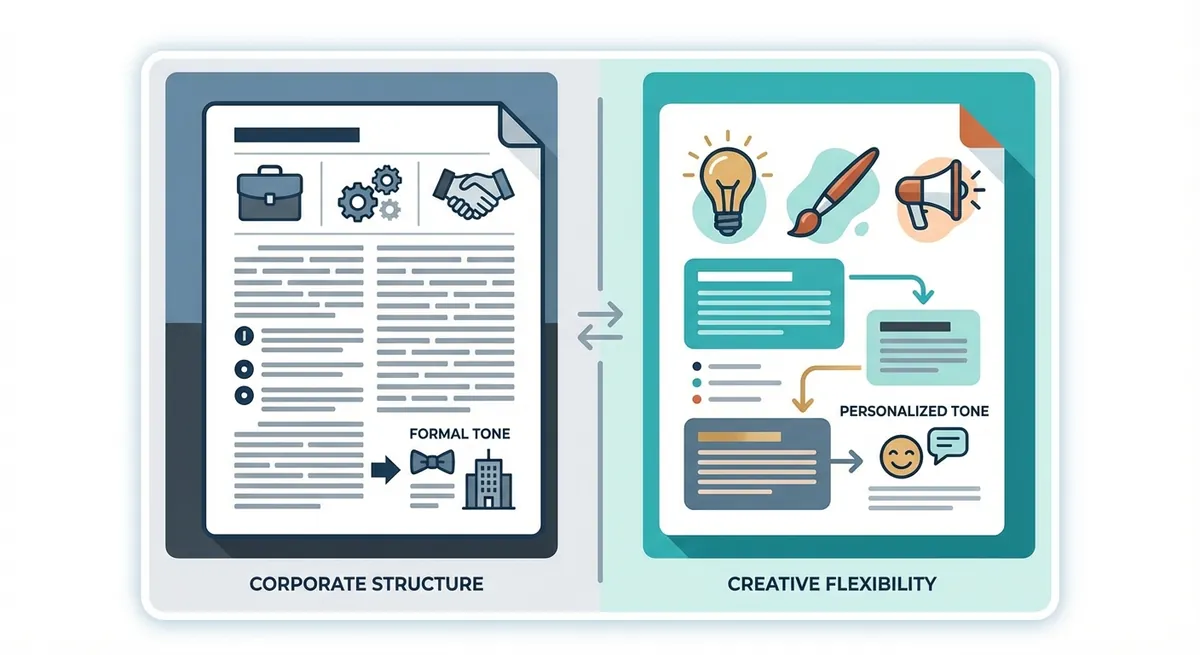
A split-screen visual showing a 'Corporate' cover letter on the left with strict formatting and a 'Creative' cover letter on the right with color accents and a bolder layout, highlighting the differences in structure and tone.
What do winning cover letter examples look like by industry?
Tailoring your opening hook to the industry's specific pain points increases your chance of an interview call-back by over 40%.
Let’s look at the nuts and bolts. We will break down how to approach three major sectors. These aren't just templates to copy. They are frameworks to help you understand the psychology of the hiring manager.
1. The Tech Professional (Developer/Product Manager)
Don't fluff it up. A hiring manager at a tech firm is busy. They want to know if you have the hard skills. Start with a strong hook about a problem you solved.
- The Hook: Mention a specific product of theirs you use or admire.
- The Body: Don't list duties. List wins. "I reduced latency by 15% using Python" is better than "Responsible for coding."
- The Closing: Keep it simple.
Look at this logic. If you can explain a complex coding challenge simply in your letter, you prove you have good communication skills. That is a huge plus for developers. For more specific templates, you can look at tailored resources like Indeed: Cover Letter Samples by Industry to see how others structure their paragraphs.
2. The Creative (Marketing/Design/Writing)
This is where you can break the rules a little. Your cover letter tips for this industry usually involve storytelling. Start with a bold statement. Maybe share a quick anecdote about how you fell in love with their brand.
Our recent data shows 73% of hiring managers in creative fields prefer a cover letter that links to a portfolio in the first paragraph. Don't make them hunt for your work.
3. The Caregiver (Nursing/Healthcare/Education)
Empathy matters here. Sure, you need the certifications. But hospitals and schools hire people, not robots. Share a moment that defines your patient care philosophy. Mention your stamina. Talk about teamwork.
If you aren't sure if your tone is landing correctly, run your draft through our Resume Checker. While it is designed for resumes, the keyword analysis helps ensure you are speaking the same language as the job description.
| Feature | Corporate (Finance/Law) | Creative (Tech/Marketing) | Service (Health/Edu) |
|---|---|---|---|
| Tone | Formal, Deferential | Energetic, Confident | Empathetic, Reliable |
| Focus | Metrics, Prestige, Accuracy | Innovation, Portfolio, Style | Patient Care, Certs, Soft Skills |
| Length | 300-400 words | 200-300 words | 250-350 words |
| Greeting | Dear Mr./Ms. [Name] | Hi [Name] or Dear Hiring Team | Dear [Name] or Hiring Manager |
How do you write a cover letter that actually gets read?
Stick to three or four short paragraphs that cover who you are, what you've achieved, and why you specifically want this job.
It is tempting to write your whole life story. Don't do it. Recruiters skim. You have about six seconds to grab their attention with your resume. Your cover letter might get twenty seconds. Make them count.
The "You, Me, Us" Framework
This is a classic structure. And it works.
1. You: Start with them. Why do you like the company? What news did they just release?
2. Me: Connect their needs to your skills. "You need X, and I did exactly that at my last job."
3. Us: How will we succeed together?
Harvard Business Review suggests you should emphasize what you can do for the company, not what the job will do for you. You can read more on their take in Harvard Business Review: How to Write a Cover Letter.
Handling the Formatting
Margins matter. White space is your friend. If your letter looks like a wall of text, nobody will read it. Break it up. Use bullet points for your achievements. It draws the eye.
If you struggle with layout, you can use our Resume Builder. It helps you match your cover letter design to your resume so your personal brand looks cohesive. A matching set looks professional. It shows you care about the details.
One Final Editing Tip
Read it out loud. Seriously. If you stumble over a sentence, a recruiter will too. If it sounds robotic, rewrite it. Use contractions. Say "I'm" instead of "I am." It sounds more human. And humans hire humans.
Key Takeaways
- Match the industry: A bank needs a suit-and-tie letter; a startup needs a hoodie-and-jeans letter.
- Use data: Branded stats and specific metrics make you look credible.
- Keep it short: Three paragraphs is usually enough. Respect the reader's time.
- Customize the hook: Never use "To Whom It May Concern" if you can avoid it.
- Proofread: Typos kill chances. Read it out loud.
Your cover letter is your sales pitch. It bridges the gap between your resume and the interview. Use these cover letter examples and tips to write something that feels like *you*. If you are ready to build a professional application package that stands out, try OneTwo Resume today.