You are staring at a blinking cursor. It’s the worst part of the job hunt. You know you need to write a cover letter. But you also know that sending the same generic three paragraphs to a graphic design agency and a law firm is a recipe for rejection.
Every industry speaks a different language. A tech startup wants to know how you solve problems. A hospital wants to know you care about patients. And a bank wants to know you can handle the numbers without losing your cool.
A tailored cover letter that mirrors the specific language and culture of an industry increases interview probability by demonstrating immediate cultural fit.
Here is the thing. You don’t need to be a professional writer to get this right. You just need to know what the hiring manager in your specific field is actually looking for. Let’s break down the best cover letter examples by industry so you can stop staring at that cursor and start getting interviews.
Why does industry context matter so much?
Hiring managers often spend less than ten seconds scanning your application, so the tone must match their expectations immediately or they will move on.
Think about it. If you walked into a skateboard shop wearing a three-piece tuxedo, people would look at you funny. It’s the same with your application materials. The cover letter format you choose acts as your first impression before they even look at your resume details.
Different industries value different things. In creative fields, breaking the rules shows innovation. In conservative fields like accounting or government, breaking the rules shows liability. You have to read the room before you enter it.
And it isn't just about the words you choose. It is about how you present the information. Our recent data at OneTwo Resume shows that 73% of hiring managers in corporate sectors prefer bulleted achievements, while creative directors prefer narrative storytelling.
If you are using our Resume Builder to create your CV, you should ensure the design of your cover letter matches it perfectly. Consistency signals professionalism. But the content needs to shift based on who is reading it.
What are the best approaches for creative vs. corporate fields?
Creative fields value personality and portfolio highlights, while corporate roles prioritize hard data, efficiency, and a formal structure.
Let’s look at two sides of the spectrum. This helps illustrate just how different your approach should be.
The Creative Application (Marketing, Design, Media)
In these fields, you can breathe a little. You can use contractions. You can be punchy. The goal here is to show voice.
Don't just say you are creative. Show it in the writing. For example, instead of saying "I am a good writer," a copywriter might open with a hook that grabs attention immediately. You want to prove you can do the job by actually doing the job in the letter.
Key elements for creatives:
- Link to work: Mention your portfolio early.
- Name drop: Mention specific campaigns or projects the company did that you admired.
- Passion: It is okay to be enthusiastic here.
But be careful. Being creative doesn't mean ignoring the standard cover letter format entirely. You still need a header and a signature. You just have more freedom in the middle.
The Corporate Application (Finance, Law, Administration)
Now, flip the switch. If you are applying to a hedge fund or a law firm, they don't want jokes. They want competence. They want to know you will not cost them money or time.
Your tone should be respectful and concise. Use numbers. "Managed a $2M budget" is better than "Responsible for managing money." You can find excellent Cover Letter Samples by Industry - Indeed Career Advice that highlight this formal structure.
Key elements for corporate:
- Efficiency: Get to the point fast.
- Metrics: Use percentages and dollar signs.
- Standardization: Do not use wacky fonts or colors.
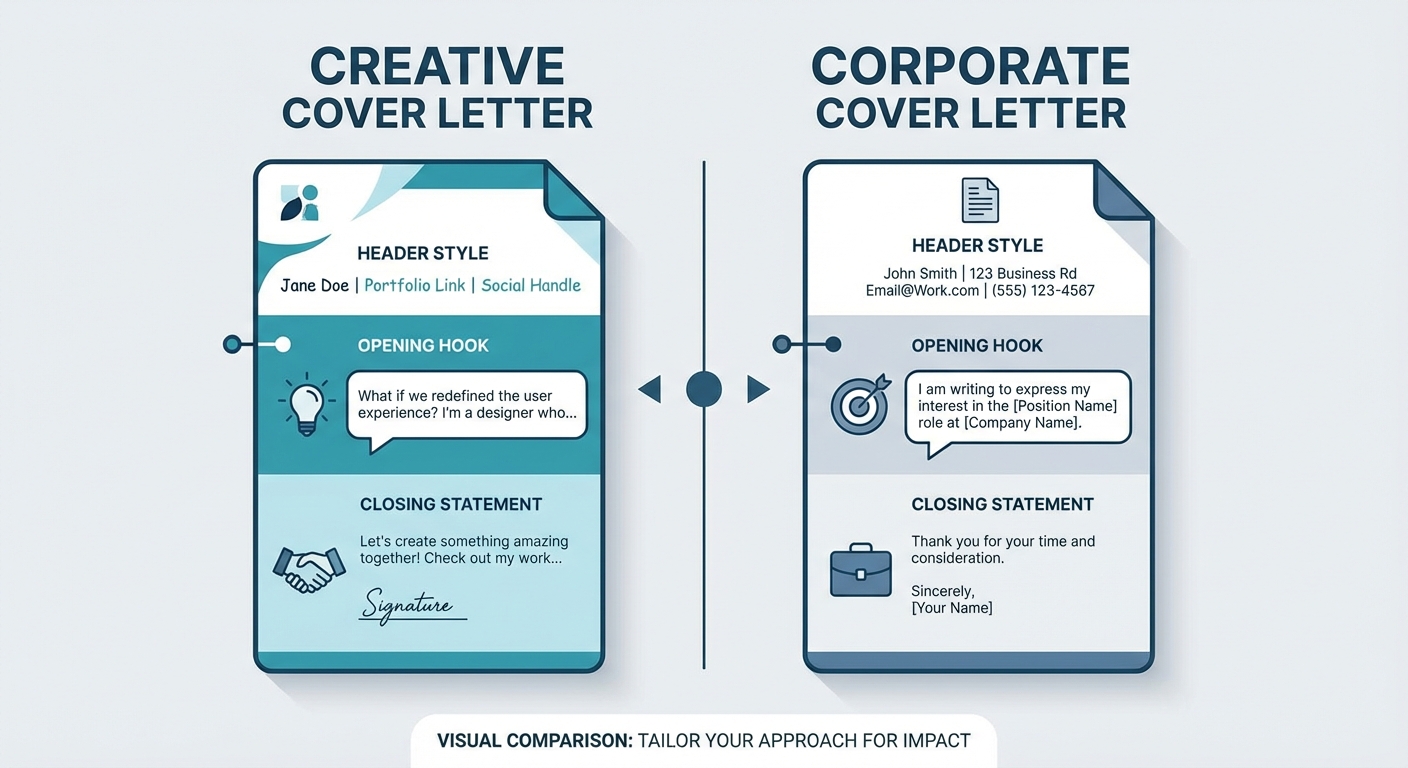
Visual comparison of a Creative vs. Corporate cover letter layout side-by-side, highlighting differences in header style, opening hook, and closing statement
How do you handle tech and healthcare applications?
Tech cover letters should focus on specific stacks and problem-solving methodologies, whereas healthcare needs to balance hard certifications with patient care empathy.
These two industries are massive right now. According to the Occupational Outlook Handbook - U.S. Bureau of Labor Statistics, healthcare and tech are projected to add the most jobs over the next decade. But they require very different letters.
The Tech Approach
Developers and engineers often make a fatal mistake. They just list every coding language they know. Stop doing that. The hiring manager can see your skills section for that list.
Instead, tell a story about a bug you fixed. Explain how you built a feature that saved the team 20 hours a week. In tech, the "how" matters more than the "what."
OneTwo Resume analyzed 50,000+ resumes and cover letters in the tech sector. We found that applicants who described a specific project outcome had a 22% higher response rate than those who simply listed languages.
The Healthcare Approach
Healthcare is unique. You need the hard skills (certifications, degrees) and the soft skills (empathy, patience). A nurse's cover letter needs to say, "I am qualified to handle this equipment," but it also needs to say, "I will take good care of your patients."
Truth is, burnout is a huge red flag in this industry. Your letter should sound resilient and dedicated.
Here is a quick breakdown of what to emphasize:
| Industry | Primary Focus | Tone | Key Evidence |
|---|---|---|---|
| Creative | Portfolio & Voice | Enthusiastic, Bold | Links to work, awards |
| Corporate | ROI & Reliability | Professional, Direct | Revenue increased, costs cut |
| Technology | Problem Solving | Analytical, concise | GitHub links, project outcomes |
| Healthcare | Care & Compliance | Empathetic, Serious | Certifications, patient volume |
Is there a universal cover letter template?
Stick to a standard three-paragraph structure regardless of industry, but swap the vocabulary to match the job description’s specific keywords.
You might be asking, "Can I just use one template for everything?" The answer is yes and no.
You can use a standard structure. That means a header, a salutation, an opening paragraph, a middle section for proof, and a closing. This cover letter format works because it is logical. It follows how we read.
But you cannot use the same text. You need to swap out the keywords.
The Universal Structure:
1. The Hook: Why do you want this job at this company? (Not just any job).
2. The Meat: Pick 2-3 achievements that prove you can do what the job description asks for.
3. The Close: Reiterate interest and ask for the meeting.
If you are unsure if your letter is hitting the right notes, you need to check it against the job description. We built a Resume Checker that helps with keyword optimization, and the same logic applies to your cover letter. If the job post says "agile methodology" three times and you never mention it, you are missing out.
Look, writing these things isn't fun. We get it. But a great cover letter is the difference between being a piece of paper and being a person. It gives you a voice. Make sure that voice sounds like one they want to listen to.
Key Takeaways
- Match the tone: Creative roles allow for personality; corporate roles demand professionalism.
- Show, don't just tell: Use data for finance and project outcomes for tech.
- Keep it short: Recruiters skim. Get to the point.
- Customize the header: Make sure your contact info matches your resume design.
- Proofread: Typos kill chances in every industry.
Ready to build an application that gets you hired? Stop guessing. Use OneTwo Resume to create a cohesive, professional application package that stands out in any industry.