Writing about yourself is tough. You sit there staring at a blinking cursor, wondering whether anyone reads these things anyway. Here is the truth: a generic cover letter gets ignored, and a tailored one gets interviews.
"Tailored" means more than swapping in the company name. A bank, a hospital, a startup and a federal agency each read a cover letter with a different checklist in mind. This guide shows how cover letters differ by industry and by job type, with a side-by-side comparison table and sample opening lines you can adapt.
In short: corporate fields (finance, law, government) want a formal, evidence-led letter; creative fields want voice and a portfolio link; technical fields want brevity and shipped work; care fields (healthcare, education) want credentials plus a human moment. Length runs from roughly 200 words in tech to 400 in law and government.
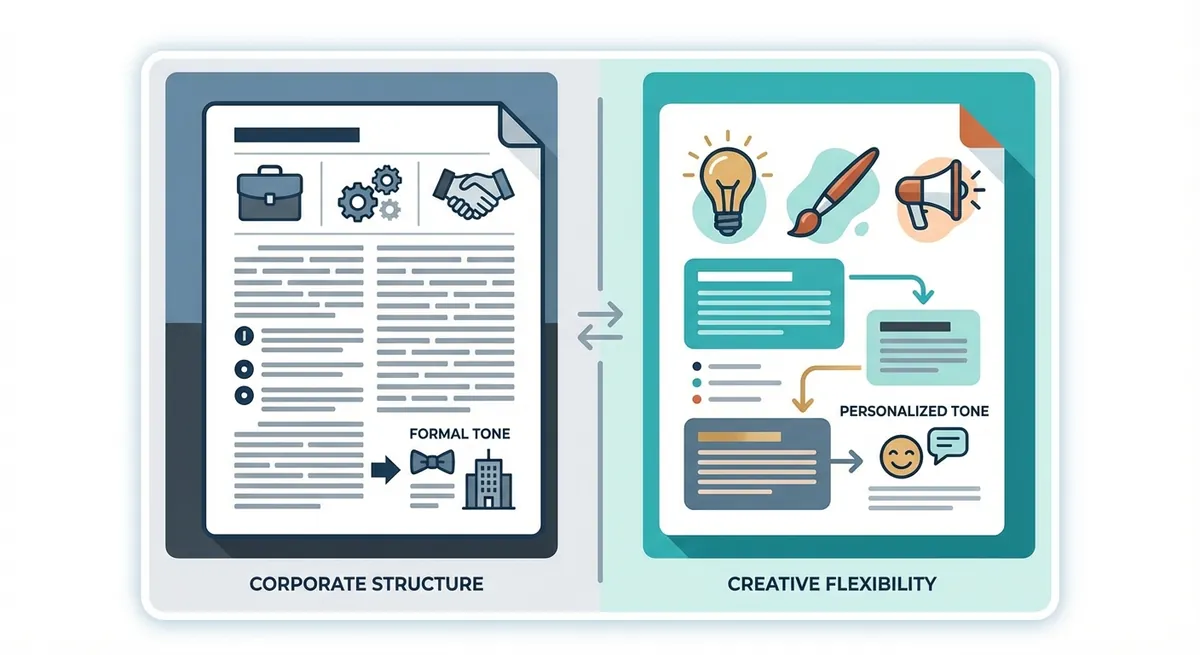
A split-screen visual showing a 'Corporate' cover letter on the left with strict formatting and a 'Creative' cover letter on the right with color accents and a bolder layout, highlighting the differences in structure and tone.
Why do different industries need different cover letter styles?
Because the person reading it is screening for different risks. A finance director is checking whether you are precise and reliable; a marketing lead is checking whether you have a voice; an engineering manager is checking whether you can build; a nursing manager is checking whether you are licensed and calm under pressure.
Context is everything. You wouldn't wear a tuxedo to a beach party, and you shouldn't send a stiff, formal letter to a startup with a slide in the lobby. The reverse is just as damaging: a casual note to a law firm signals you don't understand the room.
The letter itself is also weighted differently. In law, government and academia it is often read closely and may be required. In software and many startups it is optional and skimmed in seconds, if opened at all. Knowing which world you are writing for tells you how much to invest and where to put the evidence.
How do cover letters differ by industry?
The table below is the fastest way to see the differences. Use the row for your target field as a checklist before you send.
| Industry | Tone | Length | Lead with | Greeting | Avoid |
|---|---|---|---|---|---|
| Software / Tech | Direct, informal-professional | 150–250 words | A shipped project or a problem you solved, with the stack | "Hi [Name]," | Buzzwords, restating the resume, anything over one screen |
| Finance / Accounting | Formal, precise | 300–400 words | Quantified results (revenue, cost, accuracy, audit outcomes) | "Dear Mr./Ms. [Last name]," | Jokes, vague claims, unexplained gaps |
| Law | Formal, structured | 350–450 words | Practice-area fit, clerkships, writing samples, why this firm | "Dear Mr./Ms. [Last name]," | Casual tone, typos of any kind, generic "prestigious firm" praise |
| Marketing / Creative | Energetic, distinct voice | 200–300 words | Portfolio link in the first paragraph, one campaign result | "Hi [Name]," or "Dear [Team] team," | Templates, adjectives without work to back them |
| Healthcare / Nursing | Warm, competent | 250–350 words | License, unit/specialty, certifications, then a patient-care moment | "Dear [Name] / Hiring Manager," | Overselling, ignoring the specific unit or facility |
| Education | Professional, values-led | 300–400 words | Certification, grade/subject, teaching philosophy in one line | "Dear Principal [Last name]," | Generic "passion for children" with no classroom evidence |
| Sales / Business Development | Confident, numbers-first | 200–300 words | Quota attainment, pipeline built, deal size | "Hi [Name]," | Hedging, modesty, no numbers |
| Government / USAJOBS | Formal, literal | 300–450 words | Announcement number, the exact qualifications you meet, citizenship/clearance status | "Dear Hiring Official," | Creativity, omitting required details, exceeding stated limits |
| Skilled Trades | Plain, practical | 150–250 words | Licenses, certifications, years on the tools, safety record | "Dear [Name] / Hiring Manager," | Corporate language, anything that reads as padding |
Two notes on the table. First, "length" is guidance, not law: if a posting states a limit, that wins. Second, greeting matters more in formal fields than in casual ones, so when you cannot find a name, "Dear Hiring Manager" is safer than "To Whom It May Concern" in every industry.
What do winning cover letter examples look like by industry?
These are frameworks, not templates to copy. Each shows what to lead with and gives a sample opening line you can rewrite in your own words.
Software engineering, product and data
Don't fluff it up. An engineering manager wants to know whether you can build and whether you can explain what you built. Start with a specific piece of work, name the stack, and say what changed because of it.
- The hook: a product of theirs you use, or a problem in their domain you have already solved.
- The body: wins, not duties. "I cut p95 latency from 800 ms to 120 ms by moving session lookups to Redis" beats "responsible for backend performance."
- The closing: one sentence. Link to GitHub or a portfolio.
Sample opening: "I've used [Product] to manage on-call for two years, and last quarter I built the alerting pipeline our team wished it had: a Go service that cut false pages by roughly half."
Tech letters differ from every other industry more than any of them differ from each other. We cover that in depth in how software engineering cover letters differ from other industries.
Finance and accounting
Reliability is the product. Lead with quantified outcomes, name the frameworks and tools you work in (GAAP, IFRS, SOX, a specific ERP), and keep the structure conventional: three or four paragraphs, no design flourishes.
Sample opening: "As a senior accountant at [Company], I closed the books three days faster each month by rebuilding the reconciliation process in NetSuite, and I'd like to bring that discipline to [Firm]'s controllership team."
Law
Legal hiring managers read closely. Say why this firm and this practice group, cite the specific experience that maps to it (clerkships, moot court, matters you supported), and mention that a writing sample is attached. Proofread twice; a typo in a lawyer's cover letter is disqualifying.
Sample opening: "Your litigation group's recent work on [matter type] is exactly the practice I built toward during my clerkship with Judge [Name], where I drafted bench memoranda on [area]."
Marketing, design and writing
This is where you can break the rules a little. Creative hiring managers are hiring your voice, so a boring letter implies boring work. Open with a bold statement or a short anecdote about their brand, and put the portfolio link in the first paragraph so nobody has to hunt for it.
Sample opening: "Your spring campaign made me stop scrolling, which is rare. Here's my portfolio ([link]) and the campaign I ran last year that lifted email revenue by a third."
Healthcare and nursing
Empathy matters here, but credentials come first. State your license, specialty and certifications in the opening lines, name the unit or facility, then share one short moment that shows your patient-care philosophy. Teamwork and stamina are worth a sentence each.
Sample opening: "I'm an RN with four years in a 24-bed medical-surgical unit and current BLS/ACLS certification, applying for the night-shift position on [Hospital]'s telemetry floor."
Education
Principals want certification, subject and grade level up front, then evidence of classroom practice: a unit you designed, a data-driven intervention, family engagement. One line of teaching philosophy is enough; the rest should be examples.
Sample opening: "As a certified secondary math teacher with three years in Title I schools, I built a tiered intervention block that moved our Algebra I pass rate up two years in a row."
Sales and business development
Numbers first, always. Quota attainment, pipeline generated, average deal size, ramp time. Sales managers read cover letters the way they read a pipeline report, so give them one.
Sample opening: "I finished 2025 at 128% of a $1.1M quota selling mid-market SaaS, and I'm writing because [Company]'s move upmarket is the motion I've run before."
Government and USAJOBS
Federal and many state postings evaluate literally against the announcement. Reference the announcement number, address each required qualification in the order listed, and state citizenship, veteran preference and clearance status where relevant. Keep the tone formal and stay within any stated limits. The USAJOBS help center describes what reviewers expect in the accompanying resume.
Sample opening: "I am applying for Program Analyst, GS-0343-11, Announcement [number]. I meet the specialized experience requirement through three years of budget formulation work at [Agency], detailed below."
Skilled trades
Keep it short and concrete: licenses, certifications (OSHA 30, journeyman card, CDL class), years on the tools and a clean safety record. Many trades employers read the letter on a phone, so front-load the essentials.
Sample opening: "Licensed journeyman electrician, eight years commercial, OSHA 30 and current on NFPA 70E, available to start immediately."
How do software engineering cover letters differ from other industries?
Three ways. They are shorter (often under 200 words), they are optional far more often, and they are judged on specificity rather than polish. An engineering manager will forgive a plain style but not a vague one; a law firm will forgive plainness less and vagueness even less.
The practical consequence: in tech, spend your time on one concrete example and a link to the work. In corporate fields, spend it on structure, tone and proof of reliability. The dedicated comparison walks through the same letter rewritten for both audiences.
How do cover letters differ by job type?
Industry sets the tone; job type sets the argument. The same finance letter reads differently from a new graduate, a manager, a career changer and an internal applicant.
| Job type | The argument to make | What to lead with |
|---|---|---|
| Entry-level / new grad | "I've done the work at small scale and I learn fast" | Internships, projects, coursework with outcomes |
| Experienced individual contributor | "I've done this exact job and here are the results" | Two or three quantified achievements |
| Manager / leader | "I build teams that deliver" | Team size, what the team shipped, how you grew people |
| Career changer | "My skills translate, and here's the proof" | Transferable wins, then why this field now |
| Internal candidate | "I already know the org and I'm ready for more" | Cross-team results, relationships, what you'd do in 90 days |
Full examples for each row are in cover letter examples by job type.
How do you write a cover letter that actually gets read?
Stick to three or four short paragraphs that cover who you are, what you have achieved, and why you want this specific job. Recruiters skim: in Ladders' eye-tracking study the initial screen of a resume averaged 7.4 seconds, so assume your letter gets a quick first look too.
The "You, Me, Us" framework
- You: start with them. Why this company, what they just launched, what problem they are visibly working on.
- Me: connect their needs to your evidence. "You need X; I did exactly that at [Company], and here is the result."
- Us: how you would contribute in the first months.
The Harvard Business Review's guide to how to write a cover letter makes the same point from the hiring side: emphasize your personal value, because hiring managers are looking for people who can help them solve problems.
Handling the formatting
Margins matter and white space is your friend. If the letter looks like a wall of text on a phone, it will not be read. Match the header to your resume so the application looks like one document. If you want a first draft that already uses your resume's facts, the cover letter generator drafts one from your resume and the job posting, and the cover letter examples library has role-specific samples to start from.
One final editing tip
Read it out loud. If you stumble over a sentence, a recruiter will too. If it sounds robotic, rewrite it with contractions. Then run it through the resume checker alongside your resume to confirm the two use the same keywords as the job description.
Key takeaways
- Match the industry: formal and evidence-led for finance, law and government; voice and a portfolio for creative; short and specific for tech; credentials plus a human moment for healthcare and education.
- Match the job type: entry-level argues potential, managers argue team results, career changers argue translation, internal candidates argue readiness.
- Lead with the evidence the reader is screening for: a metric, a license, a portfolio, an announcement number.
- Keep it short: 150–250 words in tech and trades, up to 400–450 in law and government, and always within a stated limit.
- Never use "To Whom It May Concern": find a name, or use "Dear Hiring Manager."
Your cover letter is the bridge between your resume and the interview. Use the row for your field, borrow the opening line, and rewrite it until it sounds like you. When you are ready to build a matching resume and cover letter together, start with the OneTwo Resume builder.