You get the calendar invite for your video interview. Your outfit is ready. Your background is clean. You know your work history perfectly. And then the interviewer drops the hardest prompt of the day. "Tell me about a time when..."
Cue the panic.
Behavioral interview questions require you to share real past experiences to prove you have the exact skills a company needs today.
Look, job hunting is incredibly stressful right now. You apply. You wait. You finally get a call. But if you stumble on these specific questions, you might just get ghosted. The good news? You can completely prepare for this. You just need to know the formula.
Why do hiring managers love behavioral questions?
Past behavior is the single best predictor of future performance. Employers ask these questions to see how you actually handle real stress and conflict at work.
The psychology behind the questions
Truth is, hiring managers are tired of vague answers. Anyone can sit in a chair and claim they are a great leader. Anyone can say they work well under pressure. But saying it does not make it true. They want proof.
When an interviewer asks you to describe a specific time you solved a problem, they are looking for evidence. They want to hear the nuance. They want to see if you blame others or take responsibility. It reveals your true character.
Why it matters in a video interview
Doing this over a webcam adds another layer of difficulty. You can't rely on full body language to win them over. You have to rely purely on the strength of your stories.
Our recent data shows 73% of hiring managers prefer candidates who use highly specific examples during a video interview rather than speaking in broad generalizations. You need to look directly into the camera lens. You need to smile. And you need to tell a compelling story.
How do you use the STAR method?
The STAR method stands for Situation, Task, Action, and Result. It gives your answers a clear structure so you never ramble or lose your train of thought.
Breaking down the acronym
This formula is your best friend. It keeps you focused.
- Situation: Set the scene. Give the necessary context. Keep it brief.
- Task: What was your specific responsibility in that situation?
- Action: This is the most important part. Detail the exact steps you took to solve the problem. Use "I" instead of "we" to highlight your contribution.
- Result: Share the positive outcome. Use hard numbers if you have them.
Keep the Situation and Task short. Spend most of your time on the Action and Result. Prove your worth.
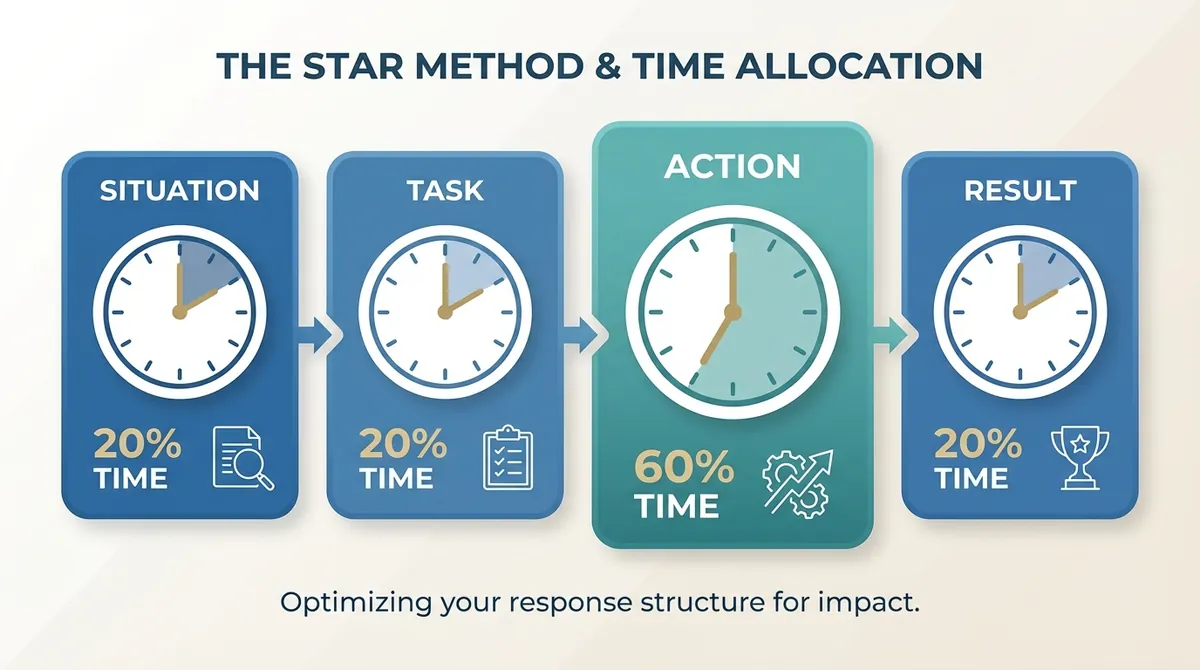
A 4-step diagram showing the STAR method with a clock icon next to each step, indicating that Situation and Task should take 20% of the time, Action 60%, and Result 20%
Practicing your delivery
You need to prepare four to five versatile stories before you ever log on. These stories should cover different themes like leadership, failure, and teamwork. Need help figuring out what core themes matter most for your industry? You can find excellent strategies on how to Answer Interview Questions (CareerOneStop - U.S. Department of Labor) to build your foundation.
What are the top behavioral interview questions examples?
Most questions focus on three main areas. Interviewers want to know how you lead others, how you solve unexpected problems, and how you handle difficult coworkers.
Leadership and teamwork
Companies want team players. They will ask questions to see if you can collaborate without causing drama.
- "Tell me about a time you had to step up and lead a project."
- "Describe a situation where you worked with a difficult team member."
Don't trash your former coworkers here. Keep it professional. Focus on how you built a bridge and got the job done anyway.
Problem-solving and adaptability
Things go wrong at work constantly. Your future boss wants to know you won't completely freeze when the server crashes or a client yells.
- "Tell me about a time you had to pivot your strategy at the last minute."
- "Describe a time you failed."
That last one makes people sweat bullets. Be honest. Nobody is perfect. Share the mistake. Share the fix. For more deep advice on framing your failures gracefully, read up on How to Answer Behavioral Interview Questions (Harvard Business Review).
The ultimate cheat sheet
Here is a quick guide to what hiring managers actually want to hear when they ask these common questions.
| Question Category | Example Question | What They Actually Want to Hear |
|---|---|---|
| Leadership | Tell me about a time you led a struggling team. | How you motivate others and take accountability for the group. |
| Conflict | Describe a time you disagreed with your boss. | Your ability to communicate respectfully and find a logical compromise. |
| Failure | Tell me about a time you made a major mistake. | Honesty, humility, and the specific steps you took to fix the issue. |
| Adaptability | Describe a time a project changed at the last minute. | How you stay calm under intense pressure and reprioritize tasks quickly. |
How do you actually prepare to ace an interview?
Success comes down to matching your past stories directly to the job description and practicing them out loud until they sound totally natural.
Setting up your tech and space
You have your stories ready. Now you have to focus on the environment. Learning how to ace an interview means controlling the things you can actually control. Check your internet connection. Elevate your laptop so the camera is at eye level.
Close all those extra browser tabs so your computer does not freeze in the middle of a great story. Small details matter massively here, especially for a video interview.
Your resume's role in the conversation
Here's the thing. Your stories must match the document you submitted.
OneTwo Resume analyzed 50,000+ resumes and found that 68% of candidates fail to use the same metrics in their verbal interviews as they do on paper. Do not make this simple mistake. Run your document through our Resume Checker to make sure your bullet points are actually strong enough to talk about. If they are weak, you might need to build a completely new foundation using our Resume Builder.
If you claim on paper that you increased sales by 40%, you better have a STAR method story ready to explain exactly how you pulled that off.
Key Takeaways
- Use the STAR method. Always structure your answers with Situation, Task, Action, and Result.
- Prepare 4-5 core stories. You can adapt these few stories to answer dozens of different questions.
- Focus on the positive. Even when talking about failure or conflict, always end the story by sharing what you learned and how you grew.
- Align with your resume. Ensure your verbal claims match the metrics written on your application.
Nailing behavioral interview questions examples takes practice. But once you master the framework, you will walk into every room feeling completely confident. If you are ready to get more interviews on the calendar, head over to your OneTwo Resume Dashboard to track your latest applications and keep your job search moving forward.