You spend hours perfecting your resume. You tweak the fonts. You check the spelling three times. You finally hit submit. And then? Silence.
It feels like your application fell into a black hole. But it probably didn't get lost. It likely got stuck in a filter.
Here is the thing about modern hiring. Before a human ever sees your qualifications, a robot reads them first. This robot is the applicant tracking system, or ATS. It’s the gatekeeper standing between you and an interview.
To get past it, you need the right resume keywords. These are the secret passcodes that tell the software you are a match. Without them, even the most qualified candidate ends up in the rejection pile.
ATS keywords are specific words and phrases describing skills and experience that algorithms use to rank your application against the job description.
Why is the applicant tracking system rejecting my application?
Robots read your resume before humans do. If you lack the exact phrasing found in the job posting, the software assumes you are not qualified and filters you out instantly.
It sounds harsh. It is harsh. But companies are flooded with applications. A single job posting might get 500 responses in 24 hours. No recruiter has time to read 500 documents. They can’t do it.
So they rely on software to do the heavy lifting. The ATS scans your file for specific criteria set by the hiring manager. These are usually hard skills, job titles, certifications, or specific software proficiency. If your resume has them, you pass. If not, you don't.
The matching game
Think of it like SEO for your career. You need to optimize your document so it ranks high in the recruiter's search results. An ATS friendly resume mirrors the language of the job description. If they ask for "project management" and you write "led various projects," the system might miss it. You have to be precise.
The cost of missing out
OneTwo Resume analyzed 50,000+ resumes and found that 68% of qualified candidates are rejected solely due to formatting issues or missing keywords. That is a massive number. It means the best person for the job often doesn't even get a phone screen. Don't let that be you.
How do I choose the right resume keywords?
Focus on hard skills that are measurable and specific to the role. While soft skills are important for the interview, the ATS algorithm prioritizes technical abilities and standard job titles.
There are two types of keywords you need to worry about. Hard skills and soft skills. The ATS cares mostly about the first group.
Hard skills vs. Soft skills
Hard skills are teachable abilities. Coding in Python. Phlebotomy. GAAP accounting. These are easy for a computer to verify. Soft skills are things like "leadership" or "communication." You should still include soft skills, but they carry less weight with the bot.
Look at the job posting. Really look at it. Highlight every specific tool, software, or certification mentioned. Those are your mandatory resume keywords. For a deeper dive on this, check out the Indeed Career Guide: How to Pick the Best Resume Keywords. They break down the selection process well.
Don't try to cheat the system
Years ago, people would paste the entire job description in white text at the bottom of their resume. Do not do this. The ATS can see it. The recruiter will see it when the text is parsed. It looks desperate. Instead, weave the words naturally into your bullet points or skills section.
If you aren't sure if your draft is hitting the mark, you can use our Resume Checker to scan your document against a specific job description. It gives you an instant score.
What are the best keywords for my industry?
Every field has a unique vernacular. Using generic terms isn't enough when the job asks for specific industry-standard software, methodologies, or certifications.
Generic advice won't help you here. A nurse needs totally different keywords than a graphic designer. Context is everything. You need to speak the language of your industry.
Our recent data shows 73% of hiring managers prefer specific software skills listed in the top third of the document. They want to know immediately if you can use their tools.
Industry Breakdown
Here is a look at high-value terms across major sectors. This isn't exhaustive, but it gives you a solid foundation.
| Industry | Hard Skill Keywords | Soft Skill Keywords | Action Verbs |
|---|---|---|---|
| Tech & IT | Python, SQL, AWS, Agile, Scrum, Full Stack, Cybersecurity, React | Troubleshooting, Collaboration, Remote work, Mentorship | Deployed, Engineered, Debugged, Automated |
| Marketing | SEO, SEM, Google Analytics, CMS, ROI, A/B Testing, Copywriting | Creativity, Adaptability, Brand awareness, Storytelling | Launched, Generated, Optimized, Increased |
| Healthcare | HIPAA, EMR/EHR, Patient Care, Triage, BLS, Acute Care | Empathy, Bedside Manner, Crisis Management, Decision Making | Administered, Treated, Monitored, Assessed |
| Sales | CRM, Salesforce, B2B, Lead Generation, Pipeline Management, Cold Calling | Negotiation, Persuasion, Resilience, Relationship Building | Closed, Negotiated, Prospecting, Expanded |
| Finance | GAAP, Financial Modeling, Excel (VLOOKUP, Pivot Tables), Auditing, Tax Compliance | Detail-oriented, Integrity, Analytical thinking, Ethics | Forecasted, Audited, Balanced, Reconciled |
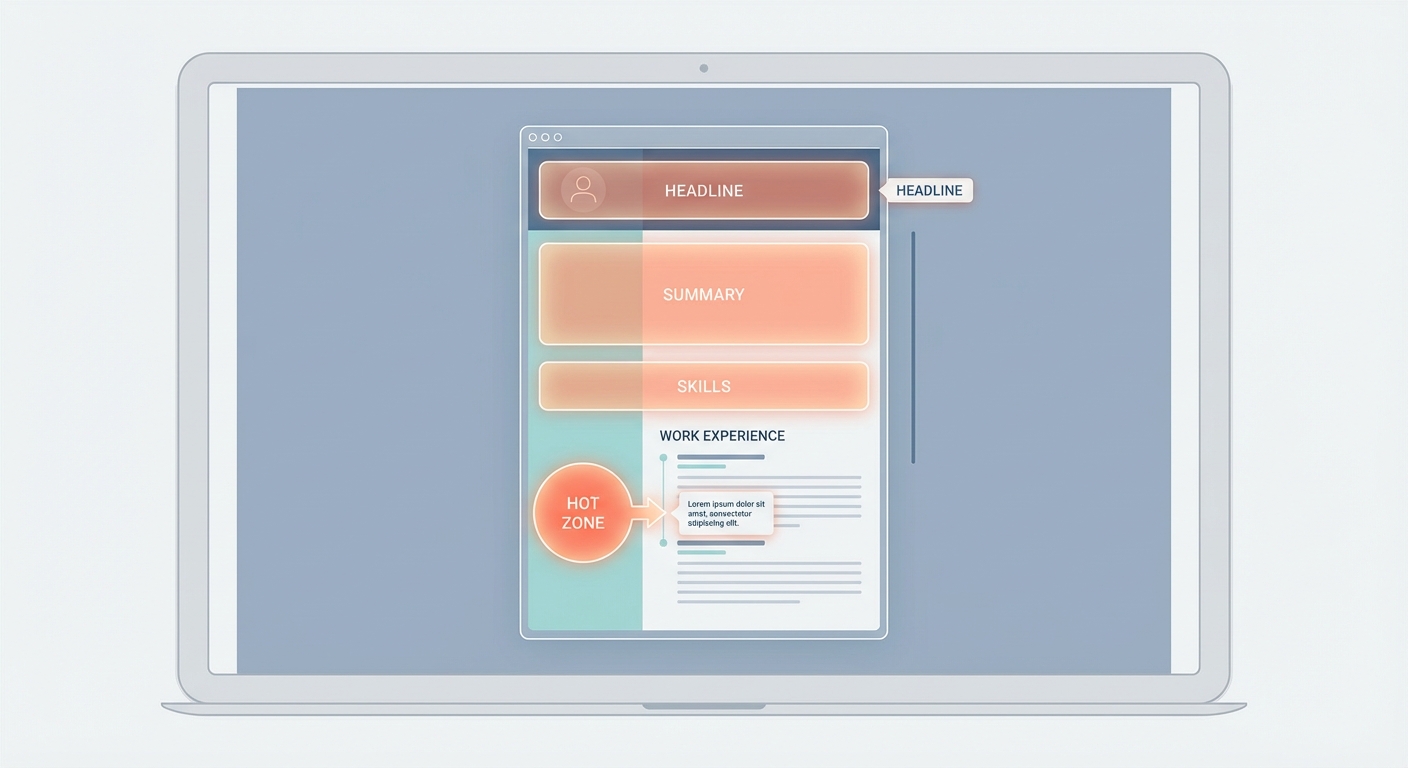
A visual diagram of a resume layout highlighting 'hot zones' where keywords should be placed, specifically the headline, summary, skills section, and the first bullet point of work experience.
Researching your specific role
If your industry isn't listed above, you have resources. The U.S. Bureau of Labor Statistics: Occupational Outlook Handbook is a goldmine of data. It lists the typical duties and required skills for hundreds of occupations. Use their language. It is often the same language HR departments use to write job descriptions.
And if you are starting from scratch, our Resume Builder has industry-specific templates with these fields built in. It takes the guesswork out of the formatting.
A note on acronyms
This is tricky. Does the ATS want "Search Engine Optimization" or "SEO"? Truth is, it might want both. The best ATS resume strategy is to write it out once and put the acronym in parentheses. For example: "Certified Public Accountant (CPA)." This covers all your bases.
Key Takeaways
- Robots go first: Your resume must pass the applicant tracking system before a human sees it.
- Mirror the job post: Use the exact wording found in the job description for your resume keywords.
- Focus on hard skills: Software names, certifications, and technical methodologies are high-value targets.
- Placement matters: Put your most critical keywords in your summary and skills section.
- Don't stuff: Keep it readable for the human who (hopefully) reads it next.
Ready to beat the bot?
Getting rejected by a computer is frustrating. But now you know how the system works. You have the codes. Go back to your resume. Scan the job description. Add the right words.
If you want to be absolutely sure your resume is ready for the real world, try OneTwo Resume today. We help you get past the filter and into the interview room.