You hit submit. You wait. And then? Silence.
It is the most frustrating part of the modern job hunt. You know you can do the job. In fact, you might be perfect for it. But for some reason, you never hear back.
Here’s the thing. You probably aren't being rejected by a human. You are getting filtered out by a robot before a real person even sees your name. It sounds dystopian, but it is just how hiring works now. Companies use software to handle the flood of applications they receive. If you don't play by the rules of this software, you don't get the interview. It really is that simple.
Tailoring your resume with industry-specific hard skills and role-based keywords is the single most effective way to beat automated screening tools.
Why do keywords actually matter?
An ATS filters candidates based on relevance, and without exact keyword matches from the job description, even qualified applicants get rejected.
Think of the applicant tracking system (ATS) as a very picky librarian. It doesn't care about your potential or your charming personality. It cares about matches. When a recruiter opens a job req, they input a list of mandatory skills and qualifications.
If the job asks for "Project Management" and you write "Led a team," the system might not connect the dots. You need to be specific.
We recently looked at the numbers to see how bad this problem really is. OneTwo Resume analyzed 50,000+ resumes and found that applications with less than a 60% keyword match rate have a near-zero chance of being read by a human.
That is a scary number.
But it is also an opportunity. If you know how the system works, you can beat it. An ATS scanner is designed to parse text and rank it. Your goal is to make that parser happy. You need to speak its language.
And you don't need to guess. There are tools that help you figure this out. Our Resume Checker simulates this process to show you exactly how an ATS views your document. It’s like getting the answers before the test.
Which keywords should you use for your industry?
Different sectors prioritize different vocabularies, so swapping generic terms for industry-standard jargon proves you know your field inside and out.
Every industry has its own secret language. Using the right terms shows you are an insider. It proves you understand the nuance of the work.
Let’s look at some specifics.
Tech and IT
In tech, specificity is king. Don't just say you "coded." That means nothing. List the languages. List the frameworks. An ATS scanner looking for "Python" won't be impressed by "Programming experience."
Also, include methodologies. Agile. Scrum. DevOps. These are huge signals that you know how modern teams operate.
Healthcare and Nursing
This field is credential-heavy.
Our recent data shows 73% of hiring managers explicitly configure their ATS to automatically disqualify resumes missing specific certification acronyms.
If you are a Registered Nurse, write "RN" and "Registered Nurse." Use both. Why? Because the recruiter might search for either one. Include specific EMR software names too like Epic or Cerner. The Bureau of Labor Statistics: Occupational Outlook Handbook is a great resource to see the exact formal titles used in your field.
Marketing and Sales
Here, it is all about results and tools.
Marketing isn't just "making ads" anymore. It is "SEO," "Google Analytics," "lead generation," and "content strategy." For sales, use terms like "CRM," "Salesforce," "B2B," and "quota attainment." These words carry weight. They imply money was made.
Here is a quick breakdown of how to swap weak language for ATS friendly resume terms:
| Industry | Weak Phrasing | Strong ATS Keyword |
|---|---|---|
| Marketing | Wrote blog posts | Content Strategy, SEO Copywriting |
| Finance | Handled money | P&L Management, Financial Modeling |
| Project Mgmt | Organized the team | Agile Methodology, Sprint Planning |
| Customer Svc | Talked to clients | Client Relationship Management (CRM) |
| Admin | Used computers | Microsoft Office Suite, Data Entry |
How do you find the right words for a specific job?
The job description itself is your best cheat sheet because it contains the exact phrasing the employer's software is programmed to find.
You don't need to be a mind reader. The company is literally telling you what they want.
Analyze the Job Description (JD)
Read the posting. Then read it again.
Look for words that pop up three or four times. If they mention "cross-functional collaboration" twice in the requirements and once in the intro, you better believe that is a keyword. Put it in your profile summary. Put it in a bullet point.
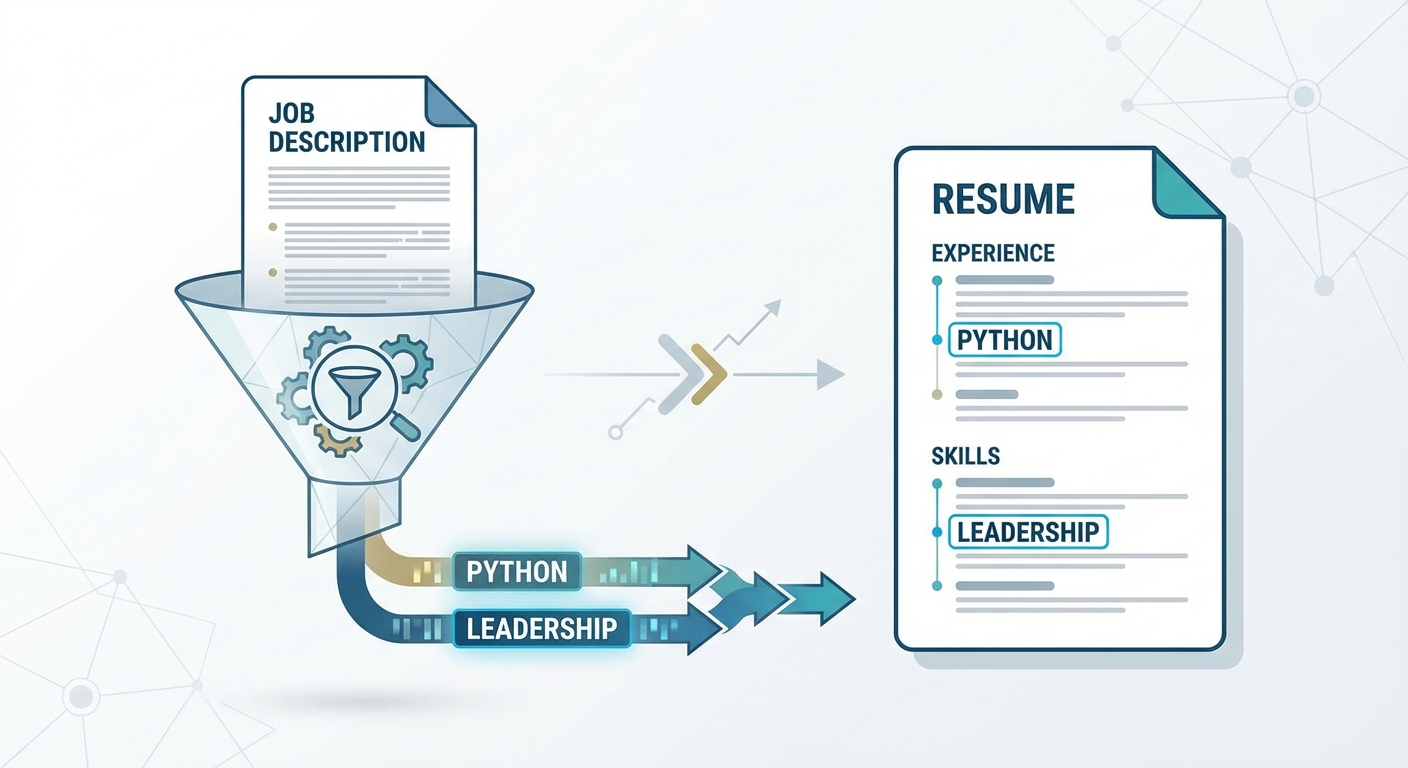
A visual funnel showing a job description going into a filter, extracting keywords like 'Python' and 'Leadership', and those keywords being placed into a resume document
Hard Skills vs. Soft Skills
Resume parsing software leans heavily on hard skills. These are teachable abilities that are easy to measure. Coding languages. Machine operation. Foreign languages. Degrees.
But soft skills matter too. Just be careful with them. "Hard worker" is fluff. "Time management" is better. "Conflict resolution" is great.
For more depth on this, Indeed Career Advice: How to Use Resume Keywords offers a solid breakdown of how to balance these two types of skills.
The "White Fonting" Myth
Someone on TikTok probably told you to copy the whole job description, paste it into your resume in tiny white font, and hide it.
Don't do this.
Seriously. Just don't.
Modern systems are smart enough to detect hidden text. It looks spammy. It looks dishonest. And if a human recruiter switches the view to "plain text," they will see a giant block of nonsense at the bottom of your page. You will get rejected immediately.
Instead, weave the words in naturally. If you need help structuring this, our Resume Builder has pre-written phrases that already include high-value keywords for dozens of industries.
Key Takeaways
- Beat the robot: An ATS scanner is the gatekeeper. You must write for the software first to get to the human.
- Be specific: Vague terms get you nowhere. Use exact software names, certifications, and industry-standard methodologies.
- Mimic the JD: The job description contains the answer key. Use their exact phrasing, not synonyms.
- Check your score: Don't send your application blindly. Test it first.
Look, getting a new job is hard enough. Don't let a computer program be the reason you stay stuck. Use the right words, optimize your format, and get your foot in the door. You've got this.