Let’s be honest for a second. Writing cover letters is often the most annoying part of the job search. You have your resume ready. You found the perfect job. But then you stare at that blinking cursor and wonder what else there is to say.
It’s tempting to rush through it. Or maybe you just copy and paste the same generic text you used for the last five applications. We have all been there. But here is the problem. Hiring managers can smell a rushed application from a mile away. They read hundreds of these things.
If you want the job, you have to do better. You need to avoid the traps that most candidates fall into. Truth is, fixing just a few small errors can double your chances of getting a callback.
Most cover letters fail because they rehash the resume word-for-word instead of telling a unique story that connects your skills to the company's specific needs.
Is your cover letter format hurting your chances?
A cluttered or overly creative layout confuses Applicant Tracking Systems and frustrates recruiters who need to find your key information in under ten seconds.
We need to talk about how your letter looks. Visuals matter. If a recruiter opens your file and sees a dense wall of text, they are going to close it. Immediately. They don't have time to squint at size 10 font.
The "Wall of Text" problem
Your cover letter format needs to breathe. It needs white space. Break your text into three or four short paragraphs. Use bullet points if you are listing achievements. This makes it scannable.
OneTwo Resume analyzed over 50,000 applications and found that cover letters with bullet points for key achievements had a 28% higher read-through rate than block paragraphs. That is a huge difference. Don't make the hiring manager work hard to read your story. Keep it clean.
Getting too fancy with fonts
Creativity is great. But your cover letter isn't an art project unless you are applying for a graphic design role. Stick to standard fonts like Arial, Calibri, or Helvetica.
If you use a curly script font to stand out, the Applicant Tracking System (ATS) might not be able to read it. And if the robot can't read it, the human never will. If you struggle with design, you can use our Resume Builder to ensure your documents look professional and parse correctly every time.
Are you writing a letter or a resume copy?
Hiring managers ignore cover letters that simply list job duties already found on the resume; they want to know how you worked, not just what you did.
This is the most common mistake we see. You attach your resume. Then you write a cover letter that lists the exact same jobs and dates. What is the point? The recruiter already has that information.
The "I, I, I" syndrome
Look at your draft. Count how many sentences start with "I". I did this. I want this job. I am hard-working.
Flip the script. Focus on them. Talk about their problems and how you can solve them.
For example, instead of saying "I have 5 years of sales experience," try saying "In my last role, I used my sales experience to help the company expand into the West Coast market." See the difference? You are providing value. For more on this approach, the Harvard Business Review: How to Write a Cover Letter offers excellent advice on shifting your focus from yourself to the employer.
Being too generic
"To Whom It May Concern."
Please stop doing this. It sounds robotic. It tells the hiring manager you didn't spend two minutes looking up their name or the department head.
Our recent data shows 73% of hiring managers prefer a personalized salutation, even if it’s just "Dear Hiring Team" rather than something stiff and outdated. Personalization shows effort. And effort gets you noticed.
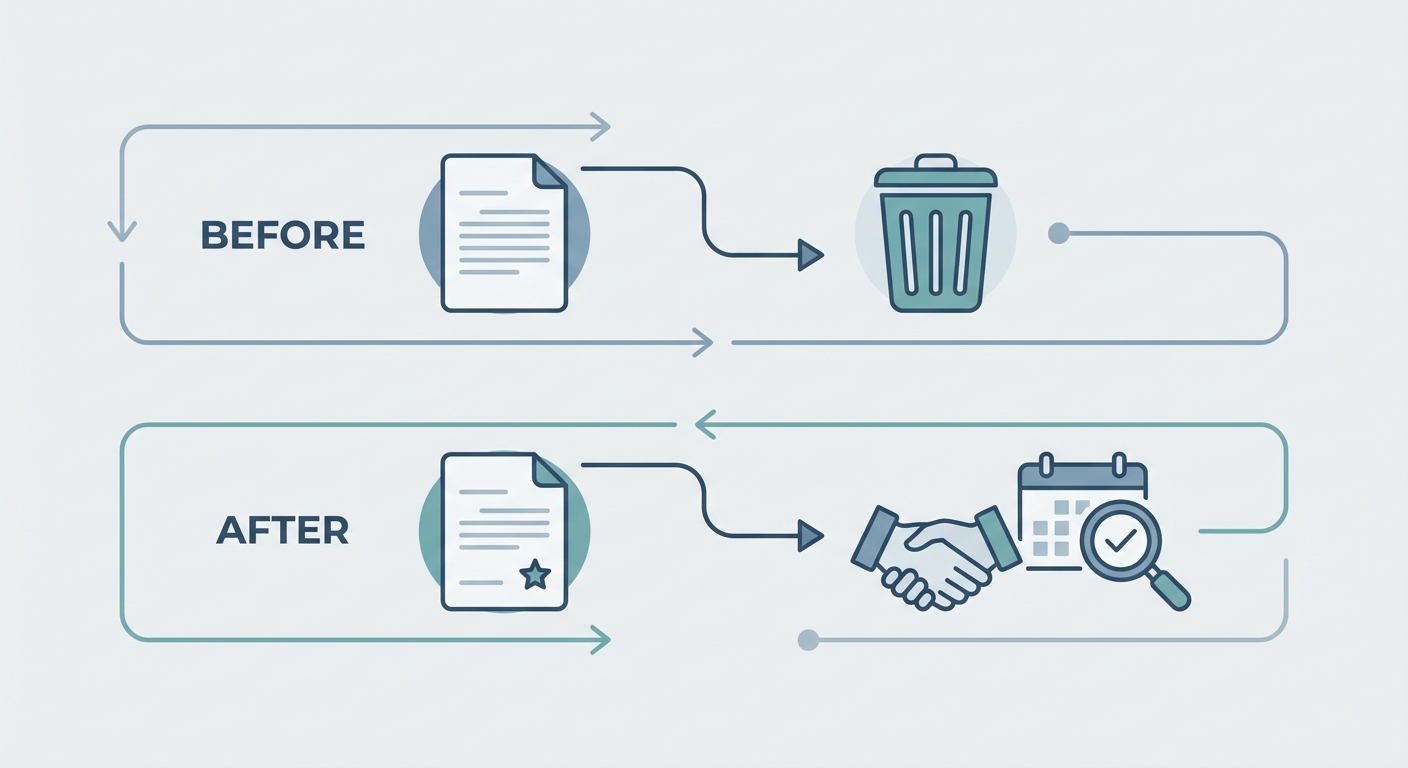
A visual flowchart showing the 'Before' and 'After' of a cover letter sentence. Top path shows a generic statement leading to a trash can icon. Bottom path shows a value-driven statement leading to an interview invite icon.
How long should a modern cover letter be?
The ideal cover letter falls between 250 and 400 words, focusing on two or three major achievements rather than a chronological history of your entire career.
Short. It needs to be short. No one wants to read a novel.
Keeping it concise
You might think a long letter shows passion. It doesn't. It shows a lack of editing skills. A good cover letter format usually fits on a single page with room to spare. Aim for three paragraphs.
1. The Hook: Why you want this specific job.
2. The Pitch: Two specific examples of past wins.
3. The Close: A call to action.
If you go over 400 words, you are risking the recruiter's patience. Be ruthless with your editing. Cut the fluff.
Using templates properly
It is okay to use a cover letter template to get started. It saves time. But you must customize it. If you forget to change the company name from your last application, you are done.
It happens more often than you think. A standard template is a guide, not a script. You have to inject your own voice. The Indeed Career Guide: Common Cover Letter Mistakes to Avoid highlights that failing to customize is a top reason for rejection. Make sure every sentence applies specifically to the job description.
If you want to make sure your application hits the right keywords before you hit send, run it through our Resume Checker. It helps spot missed opportunities in seconds.
Quick Comparison: Good vs. Bad Strategy
Here is a quick way to check if you are on the right track.
| Feature | The Mistake | The Winning Strategy |
|---|---|---|
| Opening | "I am writing to apply for..." | "I’ve been following [Company]’s work in..." |
| Focus | Listing job duties and responsibilities. | Highlighting specific achievements and results. |
| Length | Two pages of dense text. | 300 words with short paragraphs. |
| Tone | Overly formal or academic. | Professional but conversational and enthusiastic. |
| Closing | "References available upon request." | "I’d love to discuss how I can help your team..." |
Key Takeaways
- Fix your cover letter format: Use bullet points and white space. Avoid walls of text.
- Don't repeat your resume: Tell a story about a specific win or achievement.
- Keep it short: Under 400 words is the sweet spot for modern applications.
- Personalize it: Find the hiring manager's name and mention the company specifically.
- Proofread: Typos suggest you don't care about details.
Writing a great cover letter doesn't have to be a nightmare. It just requires a little focus and the right strategy. Avoid these common mistakes, and you will be ahead of 90% of the competition.
Ready to build an application that actually gets read? Try OneTwo Resume today and simplify your job search.